Heavy-Duty Grabs for Bulk Ship Unloading
Match the right grab attachment to your existing ship or port crane. ZFITA supplies heavy-duty bulk cargo grabs for applications involving coal, grain, ores and other suitable materials—configured around cargo properties, crane capacity and operating conditions.
Why Ship Unloading Grab Selection Matters
A suitable grab helps a crane handle bulk cargo in repeatable lifting cycles. Effective selection depends on the cargo—not just the advertised bucket volume.
Cargo Density & Particle Size
Grain, coal and iron ore differ in bulk density, lump size, abrasiveness and moisture. These properties affect grab size, jaw geometry and wear protection.
Available Crane Capacity
The grab's own weight and actual cargo payload must be assessed against the allowable crane load at the required working radius.
Handling & Discharge
Vessel hold access, hatch dimensions, lifting cycles and the customer's receiving arrangement influence the practical grab configuration.
How Grab-Based Ship Unloading Works
This shows the complete operating context. ZFITA's supplied component is the heavy-duty grab; the crane and downstream receiving equipment are provided by the customer's system.
Grab Types for Different Ship Unloading Tasks
Grab jaw shape and opening/closing drive method are separate selection dimensions. A clamshell grab, for example, may use a mechanical rope arrangement or a hydraulic system depending on the crane.
Clamshell Grabs
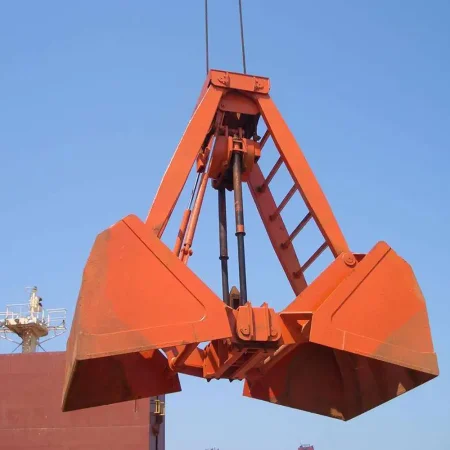
Two-jaw bucket configurations for suitable free-flowing and granular bulk cargo, including selected grain, coal and mineral handling applications.
Orange-Peel / Multi-Jaw Grabs
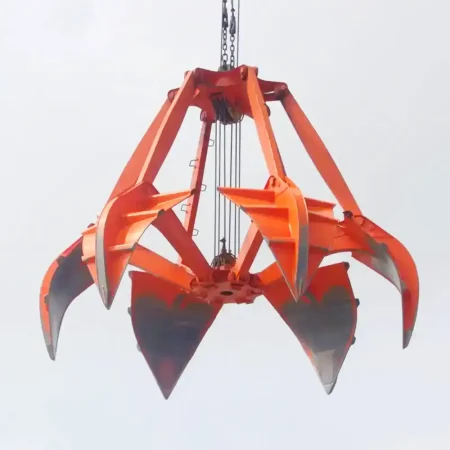
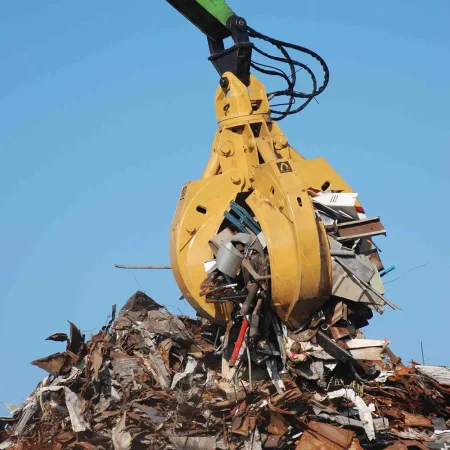
Multiple jaws may be considered for irregular, larger or more difficult-to-penetrate cargo such as certain lump materials and scrap.
Hydraulic Grabs
Hydraulic opening and closing configurations must be matched to the crane or carrier's available hydraulic supply, mounting and control interfaces.
Mechanical Rope Grabs
Rope-operated configurations depend on the crane's hoist and closing-rope arrangement. Confirm the number of ropes and reeving before selecting a grab.
When Is a Grab Attachment the Right Choice?
Grab-based unloading is one of several ways to discharge bulk cargo from ships. The method should follow the vessel, cargo, terminal conditions and available machinery.
| Method | Typical Use | Important Considerations |
|---|---|---|
| Crane + Heavy-Duty Grab | Mixed dry bulk cargo; terminals with compatible cranes | Requires matching crane SWL, grab weight, cargo and cycle time |
| Continuous Ship Unloader | Frequent, high-volume handling of compatible bulk materials | Specialized capital equipment and material-specific design |
| Pneumatic Unloader | Selected flowable bulk materials | Material properties, energy use and dust-control design |
| Excavator-Based Handling | Selected small-scale or hold-cleaning operations | Operating range, equipment access and site safety requirements |
ZFITA supplies grab attachments only; the other ship unloading methods are presented for application comparison.
Grabs for Coal, Grain, Ore & Other Bulk Cargo
Coal
Consider dust generation, cargo size, bucket closing performance and wear at jaw edges.
Grain
Consider bulk density, spillage, cleaning requirements and suitable jaw sealing arrangements.
Mineral Ore
Review high bulk density, abrasive particles, grab dead weight and wear-resistant components.
Aggregates
Assess particle size, jaw penetration, impact and crane payload allowance.
What We Need to Recommend a Grab
ZFITA can review your cargo and crane details to recommend an appropriate grab attachment configuration. No universal capacity or hourly throughput is assumed.
| Input | Information to Share | Why It Matters |
|---|---|---|
| Bulk Material | Name, bulk density, particle size and moisture | Grab shape, structural load, wear and filling characteristics |
| Crane Model | Make/model, type, rated load at working radius | Safe grab + cargo payload selection |
| Grab Drive | Rope configuration or hydraulic interface | Opening/closing compatibility |
| Target Grab Volume | Desired cubic metres, if known | Preliminary loading and capacity calculations |
| Operating Environment | Hatch sizes, discharge point, duty cycle and site photos | Jaw geometry, clearance and maintenance requirements |
| Required Throughput | Target tonnes/hour and typical crane cycle time | Feasibility review of grab size and operational productivity |
Heavy-Duty Grab Configurations
.
Application Scenarios for Grab Selection
The following scenarios explain common equipment-selection needs. They are not presented as verified ZFITA project deliveries.
Coal Terminal
Need: Operate a compatible port crane handling coal from vessel holds.
Grab approach: Review coal density, jaw closure, dust exposure and crane rated load.
Grain Cargo Handling
Need: Handle relatively free-flowing grain with a suitable crane.
Grab approach: Assess bucket filling, spillage control, cleanliness and cargo requirements.
Heavy Mineral Ore
Need: Discharge dense or abrasive mineral cargo.
Grab approach: Confirm actual payload against the crane load chart and select suitable wear-protection details.
Grab Attachment Selection & Customization
ZFITA focuses on heavy-duty grab attachments for industrial material handling. We can review cargo characteristics and existing crane information to discuss an appropriate grab configuration.
- Grab jaw type and drive arrangement selection
- Bucket size and structural configuration review
- Material-related wear and maintenance considerations
- Crane attachment and interface information review
- Project-specific quotation based on confirmed requirements
What ZFITA Does Not Supply
We do not supply complete ship unloaders, port cranes, shore hoppers or conveyor systems under this solution. Our quotation covers the specified grab equipment and agreed grab-related scope.
Ship Unloading Grab FAQs
Does ZFITA provide a complete bulk ship unloading system?
No. ZFITA supplies the heavy-duty grab attachment. The crane and downstream hopper or conveyor system are outside our stated supply scope.
What is the difference between a clamshell grab and a hydraulic grab?
Clamshell refers to the two-jaw bucket shape; hydraulic refers to how the jaws are actuated. A clamshell grab may use a hydraulic or suitable mechanical actuation arrangement.
Can the same grab handle grain and iron ore?
Not automatically. Different densities, particle sizes and wear conditions can require a different grab volume, dead weight, jaw geometry or configuration.
How do I check grab compatibility with my crane?
Share the crane model, permissible lifting load at the working radius, hoist or hydraulic arrangement, required grab capacity and cargo properties. A project-specific engineering check is required.
How is unloading capacity in tonnes per hour estimated?
It depends on actual cargo weight per grab cycle and the number of completed cycles per hour, subject to crane limits and downstream handling constraints. Bucket volume alone does not establish the hourly rate.
Can ZFITA provide custom heavy-duty grab equipment?
Grab configurations can be discussed according to material characteristics, crane interface and project requirements. Availability and specifications must be confirmed during quotation.
Get a Grab Recommendation for Your Ship Unloading Operation
Send the cargo type, bulk density, crane model and load chart, preferred grab actuation method, target capacity and vessel/terminal conditions. ZFITA can review the grab attachment requirements and prepare a project-specific quotation.