Unloading grain from shipping containers can become a major bottleneck for grain terminals, agricultural processing plants, and bulk storage facilities, especially during busy receiving seasons.
When wheat, corn, soybeans, or other suitable agricultural bulk materials arrive in 20ft or 40ft containers, the unloading operation must account for material flow, container positioning, receiving capacity, dust control, and truck traffic.
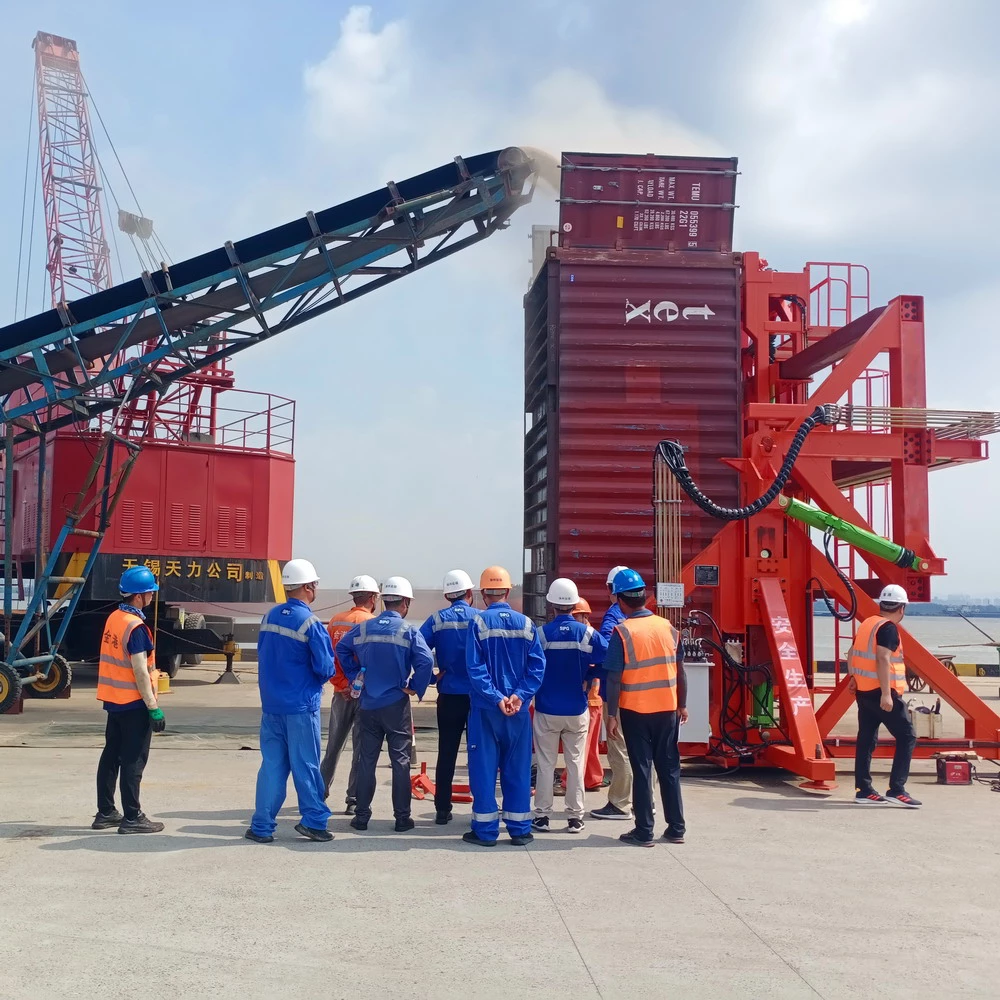
A hydraulic container tilter offers a gravity-assisted unloading method. Instead of relying on manual removal of bulk cargo, the machine secures and tilts the loaded container so that grain can discharge through a controlled outlet into a receiving hopper or conveying system.
This article explains how grain container unloading works, which equipment is required, how to choose a suitable configuration, and what buyers should consider before investing in a container unloading station.
1. What Are the Main Challenges of Unloading Grain from Shipping Containers?
Grain unloading is not simply a matter of opening the container doors.
A fully loaded container may carry a substantial quantity of agricultural material, making uncontrolled door opening and material discharge unsafe.
For facilities receiving multiple containers per day, the main challenges typically include:
Uncontrolled Material Discharge
Grain may exert pressure against the container doors, particularly when loose bulk cargo is transported using a suitable container liner or bulkhead arrangement.
The opening and discharge process must therefore follow an engineered procedure appropriate for the container and its contents.
Slow Unloading and Truck Queues
Manual or poorly coordinated unloading methods can increase the time each truck occupies the receiving station.
During seasonal grain receiving, even relatively small delays can create vehicle queues and reduce the effective capacity of the facility.
Dust and Material Loss
Dry agricultural bulk materials can generate dust during discharge and transfer.
Uncontrolled discharge may also result in spillage, housekeeping requirements, and loss of recoverable material.
Inadequate Receiving Capacity
A container tilter can release material faster than the downstream handling equipment can transport it.
If the receiving hopper or conveyor is undersized, the unloading operation may need to stop or slow down, regardless of the tilter’s mechanical capabilities.
For this reason, the container tilter, receiving hopper, feeder, and conveyor should be evaluated as a coordinated system.
2. How Does a Container Tilter Unload Grain?
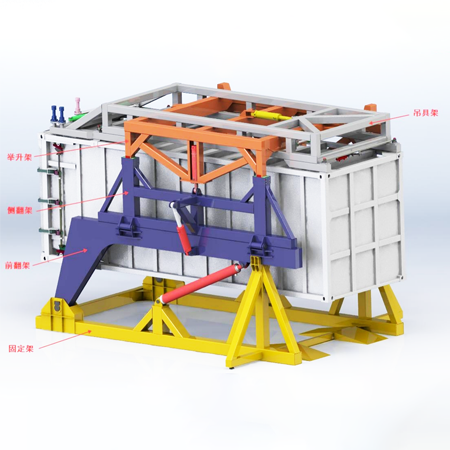
A hydraulic container tilter uses a supporting frame, container securing mechanism, and hydraulic drive system to raise and tilt a loaded shipping container.
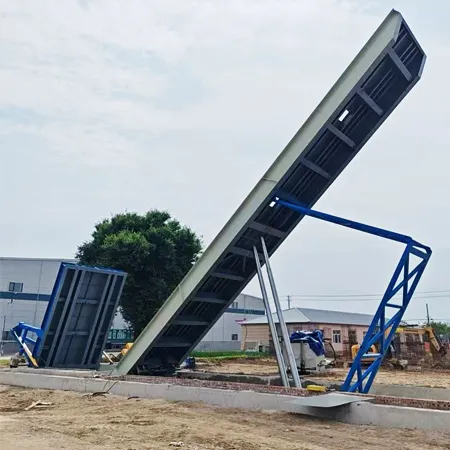
As the container reaches a suitable unloading angle, gravity causes compatible grain to move toward the discharge opening.
The operating process depends on the particular equipment design.
Step 1: Position the Loaded Container
A truck carrying the loaded shipping container enters the designated unloading area.
The container is positioned according to the equipment’s operating requirements.
Depending on the selected model, the container may be handled directly from the truck, transferred to a separate unloading position, or positioned using additional lifting equipment.
Step 2: Secure the Container
The machine engages the container using the specified locking and securing mechanisms.
Before movement begins, operators verify that the securing system, unloading arrangement, and operating area meet the required conditions.
Step 3: Prepare the Discharge Interface
The receiving hopper, container liner or bulkhead discharge arrangement, and downstream equipment must be prepared according to the approved operating sequence.
Container doors should not be opened against an uncontrolled bulk load.
Step 4: Tilt the Container
The hydraulic system gradually moves the secured container to the required angle.
The appropriate angle depends on the grain’s flow characteristics, moisture content, container configuration, and available discharge interface.
Step 5: Transfer Grain into the Receiving System
Grain discharges into the designated hopper or receiving pit.
A feeder or conveyor then transports the material to a silo, warehouse, processing line, or another storage or transfer point.
Step 6: Return and Release the Container
After unloading is completed, the equipment returns the container to its horizontal position.
The empty container is released and moved away according to the machine’s operating procedure.
3. What Equipment Is Needed for Bulk Grain Container Unloading?
The hydraulic container tilter performs the container lifting and tilting operation, but downstream equipment determines how efficiently the discharged grain can be received and transferred.
A typical unloading arrangement may include the following components.
| Equipment | Main Function | What Buyers Should Confirm |
|---|---|---|
| Hydraulic Container Tilter | Secures and tilts the loaded container | Container size, gross weight, angle and operating method |
| Receiving Hopper or Pit | Collects material discharged from the container | Volume, geometry, flow rate and dust containment |
| Feeder | Regulates the movement of material from the hopper | Required feed capacity and grain flow characteristics |
| Belt or Other Suitable Conveyor | Transfers grain to downstream storage or processing | Capacity, distance, inclination and grain suitability |
| Dust-Control Equipment | Helps manage airborne dust at transfer points | Extraction requirements, filtration and applicable safety standards |
| Weighing and Monitoring | Supports inventory or process control | Measurement location, accuracy and integration |
The complete material handling route can be arranged as:
Loaded Grain Container → Container Tilter → Receiving Hopper → Feeder → Conveyor → Silo or Storage
A facility with an existing grain receiving system may only need a suitable tilter and interface modifications.
A new receiving terminal may require the unloading machine and the downstream equipment to be designed together.
For the broader equipment arrangement, see Bulk Container Unloading Equipment & Systems.
4. Single-Lane vs. Dual-Lane Container Tilters for Grain Unloading
One of the most important purchasing decisions is selecting an equipment configuration that matches the receiving yard.
Not every grain receiving station requires a dual-lane container tilter.
Single-Lane Container Tilter
A single-lane or standard hydraulic container tilter can be suitable for a dedicated unloading position with a defined container-handling arrangement.
Potential advantages include a comparatively straightforward station layout and fewer container transfer movements, depending on the machine design.
However, the actual cycle time must account for truck positioning, container securing, tilting, discharge, returning, and removal.
Dual-Lane Container Tilter
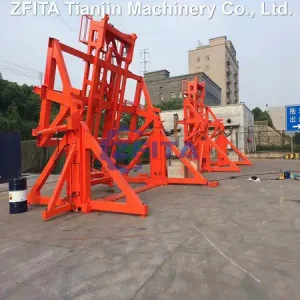
A dual-lane configuration separates the truck positioning lane from the container unloading lane.
In suitable designs, the container can be lifted from the truck and transferred sideways to the unloading area without requiring the truck itself to move during the unloading process.
This can be useful where truck positioning and material discharge must be coordinated within a busy grain receiving terminal.
What Does Double-Side Tilting Mean?
Double-side tilting refers to the equipment’s ability to operate in different tilting directions, according to its design.
It can provide greater flexibility where trucks or containers arrive with different door orientations.
This should not be confused with dual-lane operation. Lane arrangement and tilting direction describe separate aspects of the equipment.
| Selection Factor | Standard / Single-Lane Arrangement | Dual-Lane Arrangement |
|---|---|---|
| Site layout | One primary operating position | Separate truck and unloading lanes |
| Container transfer | Depends on machine design | May include lateral container transfer |
| Truck movement | Depends on operating sequence | Can allow the truck to remain stationary |
| Installation space | Depends on equipment dimensions | Requires space for multiple operating lanes |
| Operating complexity | Model-dependent | Additional transfer and coordination functions |
| Best fit | Dedicated receiving stations | Facilities with more complex truck and container handling requirements |
Neither configuration is universally faster or better. The decision should be based on the required operating process and verified cycle performance.
5. Real ZFITA Project: Agricultural Bulk Container Unloading in Shandong, China
ZFITA supplied two ZCT-DD dual-lane, double-side container tilters to Shandong Baojiang Agricultural Development Group Co., Ltd.
The customer needed a container unloading arrangement suitable for concentrated receiving periods when large volumes of agricultural bulk materials arrive at the facility.
Customer Requirements
The receiving operation required a system that could:
- Handle concentrated periods of high container arrivals.
- Reduce unnecessary truck repositioning during unloading.
- Accommodate different container door orientations.
- Support repeated unloading cycles.
- Provide reliable long-term operation.
ZFITA Equipment Configuration
The project used two ZCT-DD units featuring dual-lane container handling and double-side tilting capability.
In this design, the loaded truck enters the designated lane and stops.
The equipment secures and lifts the container from the truck, transfers it laterally to the adjacent unloading lane, and performs the unloading operation.
After the material has discharged, the container is returned to the horizontal position, moved back to the truck lane, and lowered onto the original truck.
Project Equipment Summary
| Parameter | Project Information |
|---|---|
| Customer | Shandong Baojiang Agricultural Development Group Co., Ltd. |
| Equipment | ZCT-DD Container Tilter |
| Quantity | 2 Sets |
| Configuration | Dual-Lane, Double-Side |
| Application | Agricultural Bulk Container Unloading |
| Truck Handling | Truck remains stationary during the unloading cycle |
| Container Movement | Lift → Lateral Transfer → Tilt → Return |
| Reported Operating History | Four years of stable operation |
What Does This Project Demonstrate?
The project illustrates how a container unloading station can be designed around the customer’s truck traffic and container handling process.
Its value is not limited to the hydraulic tilting movement.
The dual-lane design separates container handling from truck positioning, while double-side operation offers flexibility for different container orientations.
ZFITA reports that the two machines have remained in stable operation for four years.
This is a useful example for agricultural bulk receivers evaluating a more integrated container unloading arrangement. It does not establish a universal unloading time or throughput for other installations.
Read the full ZCT-DD Dual-Lane Double-Side Container Tilter Project.
6. How to Select a Receiving Hopper and Conveyor for Grain Unloading
Choosing the container tilter is only part of the equipment selection process.
The hopper and conveyor must receive and transfer the grain without creating excessive accumulation, dust, spillage, or unnecessary interruptions.
Receiving Hopper Capacity
The hopper should accommodate the expected material discharge behavior and the downstream feeder’s capacity.
Its geometry must be suitable for the type of grain and the unloading arrangement.
Conveyor Capacity
The conveyor should be selected using the required material throughput, conveying distance, inclination, and grain handling requirements.
The receiving line’s capacity can limit the effective unloading performance even when the tilter operates correctly.
Grain Flowability
Wheat, corn, soybeans, and other commodities have different bulk densities, flow characteristics, and moisture conditions.
Material that flows freely under one set of conditions may behave differently when moisture content increases.
Dust Management
Transfer points and receiving stations should be assessed for appropriate dust control.
Depending on the grain and operating environment, additional controls may be needed for combustible agricultural dust, housekeeping, equipment selection, and safe operation.
Existing Storage Infrastructure
If the facility already operates grain conveyors or storage silos, buyers should confirm whether the new unloading station can connect to those systems.
The mechanical, electrical, and operational interfaces should be defined before equipment procurement.
7. How to Choose a Container Tilter for Your Grain Receiving Facility
Before ordering a grain container unloading system, buyers should evaluate the following factors.
Container Size and Loaded Weight
Confirm whether incoming cargo uses 20ft containers, 40ft containers, or both.
Provide the maximum gross container weight and details of the container configuration.
Do not assume that a 20ft-rated machine can accommodate 40ft containers or that the rated capacity represents the allowable grain payload.
Grain Type and Condition
Provide the commodity name, bulk density, moisture range, and any relevant liner or bulkhead specifications.
The discharge arrangement must be compatible with the actual container and cargo preparation method.
Containers per Hour
Establish the required unloading workload, including peak seasonal demand.
The actual cycle must include container positioning, locking, transfer if applicable, tilting, discharge, reset, and vehicle clearance.
Available Site Space
Provide a layout indicating truck entry and exit, operating lanes, receiving hopper location, equipment clearance, and available ground conditions.
A dual-lane system may offer operational advantages, but it also requires an appropriate site layout.
Downstream Grain Handling
Identify where the grain must go after discharge.
The receiving hopper, conveyor, storage system, and control arrangement should be evaluated as one material handling process.
Maintenance and Support
Ask the manufacturer about hydraulic maintenance, equipment inspection, spare parts, safety documentation, and commissioning support.
The proposed equipment must be suitable for the facility’s operating frequency and maintenance capabilities.
8. What Should You Send to a Grain Container Unloading Equipment Supplier?
To obtain a practical equipment proposal, prepare the following information.
| Requirement | Information to Provide |
|---|---|
| Grain Type | Wheat, corn, soybeans, or other agricultural commodity |
| Container Size | 20ft / 40ft / mixed fleet |
| Loaded Weight | Maximum gross container weight |
| Container Preparation | Liner, bulkhead and approved discharge interface |
| Required Throughput | Containers per hour or per shift; grain tonnes per hour |
| Operating Layout | Truck traffic, lane arrangement, available dimensions |
| Receiving Equipment | Existing hopper, feeder, conveyor and silo connections |
| Environmental Conditions | Dust-control requirements, indoor/outdoor installation |
| Power Supply | Available voltage and frequency |
| Project Scope | Standalone container tilter or integrated unloading station |
Providing this information allows the supplier to evaluate the container tilting machine and its downstream interfaces together.
For equipment configurations, visit the ZFITA Container Tilter Product Range.
9. Frequently Asked Questions
Can a container tilter unload wheat, corn, and soybeans?
Suitable container tilter configurations can be used for compatible agricultural bulk materials. Equipment suitability depends on the commodity, loading arrangement, flowability, moisture, and receiving system.
Can a container tilter unload both 20ft and 40ft grain containers?
Different models are available for different container sizes. Some configurations may accommodate both, but container compatibility must be confirmed for the specific equipment.
Is a dual-lane container tilter necessary for a grain terminal?
Not always. A dual-lane system may be useful where truck positioning and container unloading need to occur in separate operating areas. A simpler configuration may be sufficient for other facilities.
Does a container tilter unload the grain while the truck remains underneath?
That depends on the equipment. Certain designs lift and transfer the container away from a stationary truck, while other arrangements use different container positioning methods.
Does grain unloading require a receiving hopper?
Most bulk receiving arrangements need an appropriate method of collecting discharged grain. Whether that uses a hopper, receiving pit, or another engineered transfer interface depends on the facility.
Can a container tilter eliminate grain dust?
No. Controlled discharge and suitable transfer equipment may help manage dust, but additional dust extraction and protection measures may be needed.
How fast can a container tilter unload a grain container?
Actual performance depends on material flow, container preparation, tilting operation, receiving capacity, and the complete equipment cycle. A project-specific estimate is required.
What is the difference between a container tilter and a truck dumper for grain unloading?
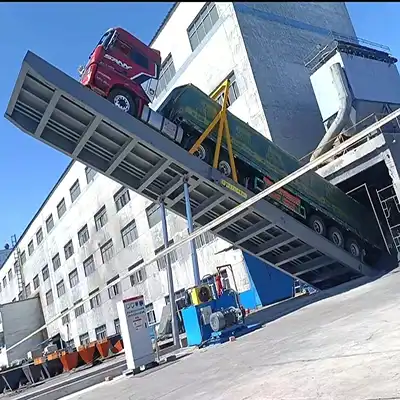
A container tilter tilts the secured shipping container. A truck dumper tilts the truck or trailer on a hydraulic platform. They involve different handling arrangements and site requirements.
Conclusion
Hydraulic container tilters provide a practical way to unload compatible grain and agricultural bulk materials from shipping containers using gravity.
However, successful grain container unloading requires more than selecting a machine with sufficient lifting capacity.
The container size, cargo condition, unloading interface, site layout, receiving hopper, conveying equipment, and required throughput must all be considered.
For facilities handling seasonal agricultural bulk shipments, the right equipment configuration can help coordinate container handling with the grain receiving process.
The ZFITA ZCT-DD project demonstrates how dual-lane container transfer and double-side tilting can be applied to a real agricultural receiving operation.
If you are planning a new grain container unloading station, review the ZFITA Container Tilter Equipment Range and the Bulk Container Unloading System to identify a suitable starting configuration.