Bulk Truck Unloading Equipment & Systems
Unload grain, DDGS, minerals and other suitable dry bulk materials from trucks using engineered hydraulic truck dumpers, receiving pits and downstream conveying systems. ZFITA helps select the right unloading layout for your vehicles, material and site.
Why Conventional Bulk Truck Unloading Becomes a Bottleneck
A bulk receiving station has to handle the truck, the material and the next process—not just lift a platform.
Long Truck Queues
Reversing, positioning and repeated handling can restrict receiving throughput. Layout selection should reflect the actual traffic route and unloading cycle.
Residual or Cohesive Material
DDGS and other cohesive bulk products may remain inside the truck body after gravity discharge. Site-specific vibration or flow-assistance options may help.
Receiving-Pit Constraints
A truck dumper alone does not define full station capacity. Hopper geometry, dust control and conveyor discharge rate must be coordinated.
From Loaded Truck to Storage or Processing
A typical bulk truck unloading system connects the hydraulic tipper with material reception and transfer equipment.
Truck Entry
Vehicle approaches the station and is positioned on the platform.
Securing & Tipping
Approved restraints are engaged and the hydraulic platform raises the truck.
Receiving Pit
Bulk material discharges by gravity into the designed hopper or pit.
Conveyor Transfer
Suitable downstream equipment moves material to the next process.
Truck Exit
The platform returns, restraints release and the empty truck exits.
Engineering note: Hopper/conveyor design, truck restraints and discharge arrangements depend on the site. This is not a claim that every listed component is supplied as standard with each truck dumper.
Which Bulk Truck Unloading Method Fits Your Site?
| Method | Typical Fit | Considerations |
|---|---|---|
| Self-tipping truck | Vehicles with their own tipping body | Requires suitable vehicle fleet, discharge area and ground clearance. |
| Stationary hydraulic truck dumper | Dedicated industrial receiving station for compatible bulk trucks | Civil foundation, vehicle weights, deck geometry and safe truck positioning. |
| Mobile / relocatable truck dumper | Operations where the unloading position may change | Actual mobility method, stability, site preparation and rated load must be specified. |
| Mechanical / pneumatic unloading | Materials and vehicle types engineered for these systems | May require special vehicle connections, dust systems or material-specific equipment. |
ZFITA Hydraulic Truck Dumper Configurations
Choose the equipment around the receiving location and truck route. Foundation type and traffic pattern are separate selection dimensions, not four unrelated product families.
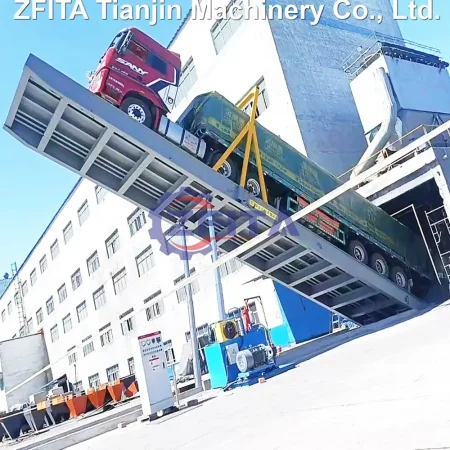
Stationary Hydraulic Truck Dumper
Common published series include 100T, 120T and 150T options, with typical 17 × 3 m platforms and 40°/45° tipping arrangements. Deep/shallow foundation and drive-through/back-on layouts depend on model and site.
Explore Truck Dumper Equipment →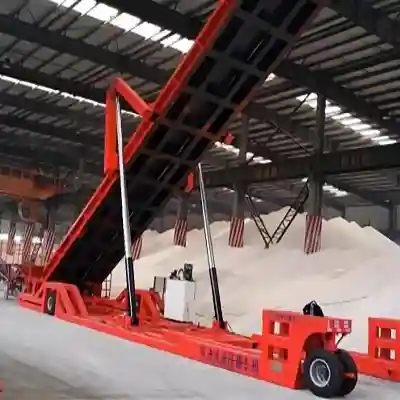
Mobile / Relocatable Truck Dumper
For locations that may require a changing unloading position, a portable or relocatable configuration can be evaluated. Transport method, setup requirements and rated performance must be confirmed for the chosen design.
Compare Truck Dumper Options →Model-specific limits: Do not apply project-specific 55° tilt angles or 80T drive-through configurations to every stationary or mobile model. Confirm drawings and rated capacities before quotation.
Receiving Pit, Hopper, Conveying & Site Layout
Bulk truck unloading is a station design problem. The receiving hopper must accept the truck discharge without uncontrolled overflow or material bridging, while downstream conveying should match the planned operating cycle.
- Foundation: deep or shallow arrangements based on site and structure.
- Traffic: drive-through or back-on according to access and queue flow.
- Material: free-flowing grain versus cohesive DDGS or abrasive minerals.
- Transfer: pit storage, belt/screw conveyor compatibility and discharge route.
- Safety: vehicle restraint, operator interlocks and site risk assessment.
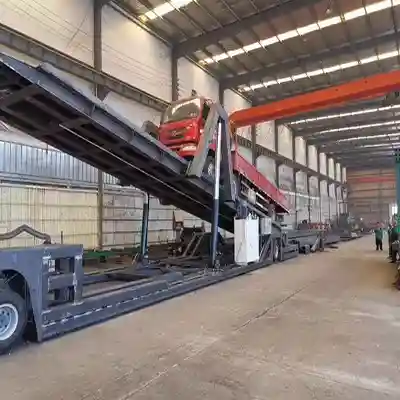
Truck Unloading Solutions by Material
Grain & Rice
Focus on truck traffic, gentle bulk reception, pit capacity and downstream grain transfer.
DDGS & Feed Ingredients
Assess adhesion, remaining material, potential vibration assistance and cleaning requirements.
Mineral & Industrial Bulk
Review abrasiveness, particle size, moisture, truck loading pattern and hopper wear protection.
Fertilizer
Check caking, corrosion, potential dust and compatible receiving/transfer materials.
Biomass
Evaluate fiber content, bridging tendency, moisture and discharge geometry.
Other Dry Bulk
Provide a material sample or specification for a feasibility assessment rather than assuming universal suitability.
Real Truck Dumper Unloading Applications
The following cases are drawn from ZFITA's published truck-dumping projects. They are not container-tilter installations.
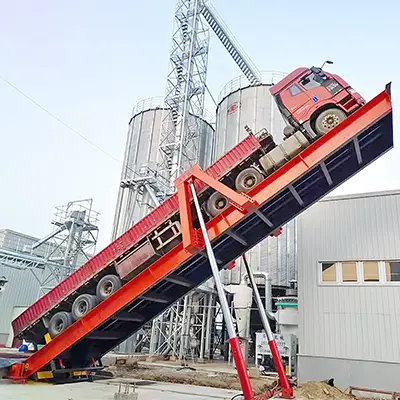
Heilongjiang Liangshi Food — Drive-Through Truck Dumping Systems
Customer need: Receive bulk rice trucks with a straightforward forward-entry and forward-exit traffic route.
ZFITA solution: Three foundation-mounted drive-through systems with a front pit-cover deck, main hydraulic rear-tipping deck and wheel restraint. Published project maximum tilt: 55°.
Project outcome: Equipment was installed and commissioned for a repeatable bulk rice receiving operation; no unverified hourly throughput is claimed.
View verified project →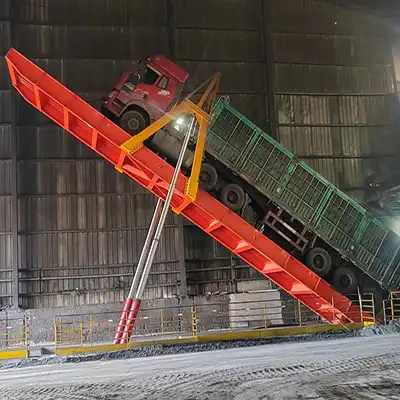
Beijing Dabeinong — Hydraulic Truck Dumper for DDGS
Customer need: Improve the discharge of cohesive DDGS that can remain stuck to truck body surfaces.
ZFITA solution: Rear-tipping truck dumper with a published maximum 55° angle and side-mounted vibration devices to assist residual discharge.
Project outcome: The configuration addresses remaining material through gravity and vibration-assisted flow, without claiming a measured savings percentage.
View verified project →What ZFITA Needs to Design Your Unloading Station
Send the following information so the equipment selection reflects your actual vehicle fleet, site geometry and discharge requirements.
| Project Input | Why It Matters |
|---|---|
| Truck type, wheelbase, maximum gross vehicle weight | Platform length, loading and restraint engineering |
| Material, bulk density, moisture, particle size | Flow characteristics, receiving hopper and potential auxiliary discharge |
| Truck arrivals per hour and daily working schedule | Station count, cycle and receiving throughput planning |
| Available foundation depth and site drawings | Deep/shallow foundation choice and civil works |
| Traffic path and unloading lane arrangement | Drive-through or back-on layout |
| Downstream destination and conveying capacity | Receiving pit/hopper and transfer-system integration |
| Local electrical supply and operating environment | Hydraulic power unit, controls and protection |
Bulk Truck Unloading Frequently Asked Questions
What is the difference between a truck dumper and a container tilter?
A truck dumper raises a loaded truck on a platform to discharge loose material. A container tilter secures and tilts the shipping container itself. Each requires different vehicle/container restraint, loading and foundation arrangements.
Can a stationary truck dumper handle 100–150 tonne loads?
ZFITA publishes stationary truck dumper variants in the 100T, 120T and 150T classes. The correct model depends on truck dimensions, maximum gross weight, load distribution and the verified equipment datasheet.
Can the station be designed for drive-through trucks?
Yes, selected configurations support forward-in/forward-out operations. The entry deck, receiving pit, vehicle restraint and yard route must be designed together.
Can you unload sticky DDGS?
ZFITA has published a DDGS truck dumper project with 55° rear tipping and vibration assistance. Feasibility depends on the actual material and vehicle body, so not every model includes vibration as standard.
Does every system include receiving hoppers and conveyors?
No. These form part of a complete unloading station concept, but supply boundaries and compatible downstream equipment must be defined in the project quotation.
What should I send for a quotation?
Truck dimensions and weight, material data, desired unload rate, site/foundation drawings, access route, electrical supply and receiving/conveying requirements.
Plan a Bulk Truck Unloading System With ZFITA
Tell us what your trucks carry, how often they arrive and where the unloaded material needs to go. We can review stationary or mobile dumping options, receiving arrangements and engineering requirements.