What Machine Can Tilt a Shipping Container for Unloading?
If you need to unload bulk material from a shipping container, a container tilter is one of the machines specifically designed for this purpose.
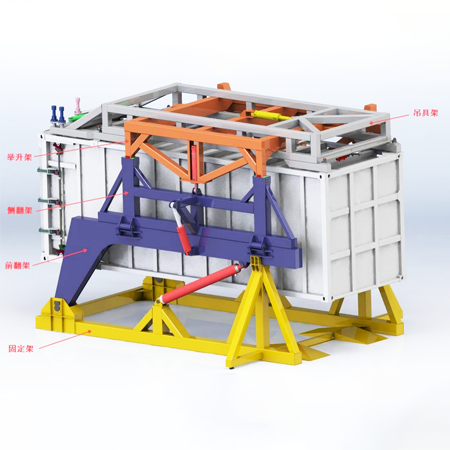
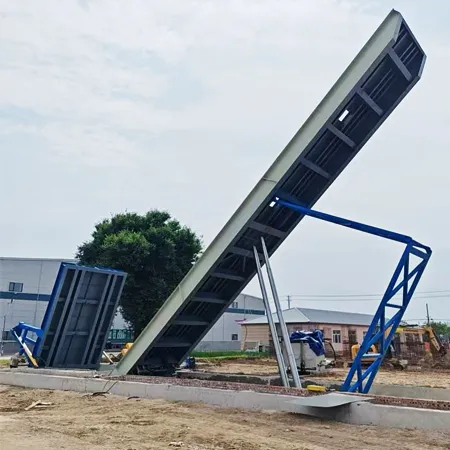
A container tilter hydraulically raises and tilts a shipping container, allowing bulk materials to flow out through the container doors by gravity. Depending on the material and unloading process, vibration equipment can also be integrated to help discharge materials that do not flow easily.
For applications involving fertilizer, potash, grain, biomass, salt, minerals, scrap metal and other bulk materials, a hydraulic container tilter can provide a controlled and efficient alternative to manual unloading or conventional material-handling methods.
What Is a Container Tilter?
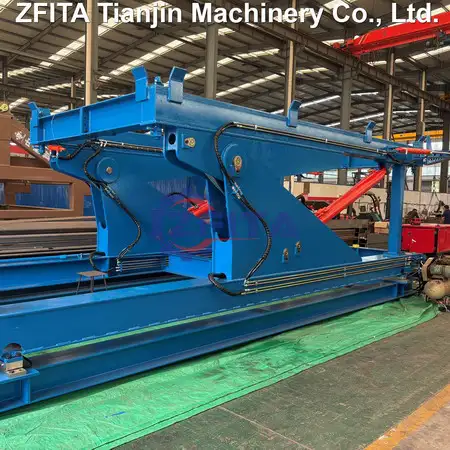
A container tilter is a hydraulic material-handling machine designed to tilt standard ISO shipping containers for loading or unloading bulk materials.
Instead of unloading the material manually from inside the container, the machine lifts one end of the container and gradually increases the tilting angle. Once the container reaches the required position, the bulk material can discharge through the open container doors into a receiving hopper, conveyor, truck, or other downstream equipment.
The basic operating principle is simple:
Container positioning → Hydraulic lifting → Controlled tilting → Bulk material discharge → Container return
This makes the container tilter particularly suitable when the material needs to be unloaded quickly without manually removing bags, using additional lifting equipment inside the container, or transferring the material into smaller packages.
How Does a Container Tilter Unload a Shipping Container?
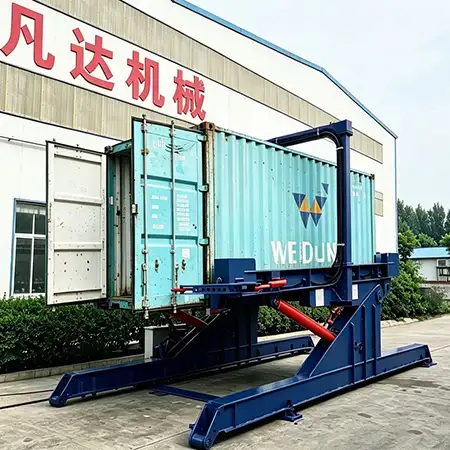
A typical container unloading process using a hydraulic container tilter consists of several steps.
1. Position the container
The loaded shipping container is positioned on the container tilter. Depending on the machine configuration, the container can be transferred onto the equipment by a truck, reach stacker, forklift, or other container-handling equipment.
2. Secure the container
The container is mechanically secured to the tilter before the hydraulic lifting operation begins. Proper locking and positioning are important because the equipment must safely handle the combined weight of the container and its contents.
3. Raise and tilt the container
The hydraulic system gradually raises the container to the required unloading angle.
For conventional container tilting applications, the machine can typically tilt the container toward the unloading side, with the exact maximum angle determined by the equipment design and application requirements.
4. Discharge the bulk material
Once the container reaches the required angle, the container doors are opened and the material flows out through gravity.
The discharged material can be collected by a hopper, conveyor, truck, or another material-handling system.
5. Return the container
After unloading, the hydraulic system lowers the container back to its original position so that the empty container can be removed and another loaded container can be processed.
Why Use a Container Tilter for Bulk Material?
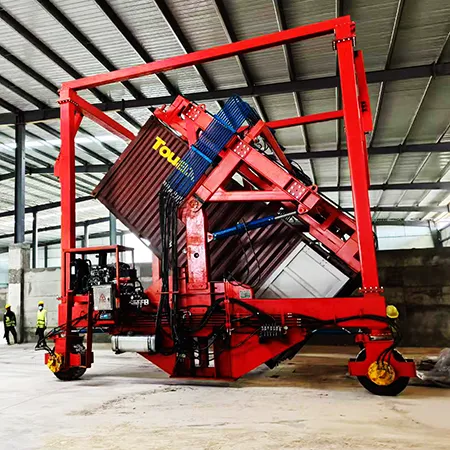
The main advantage of a container tilter is that it changes the unloading process from manual material removal to controlled mechanical discharge.
This can be particularly useful when containers are filled with loose bulk materials rather than palletized or bagged products.
A container tilter can help:
- Reduce manual unloading work
- Improve unloading efficiency
- Handle heavy bulk materials
- Reduce the need for workers to enter the container
- Integrate with hoppers and conveyors
- Support continuous bulk material handling
- Improve the overall unloading workflow
For high-volume operations, the tilter can also be integrated into a larger unloading system rather than operating as an isolated machine.
What Materials Can Be Unloaded With a Container Tilter?
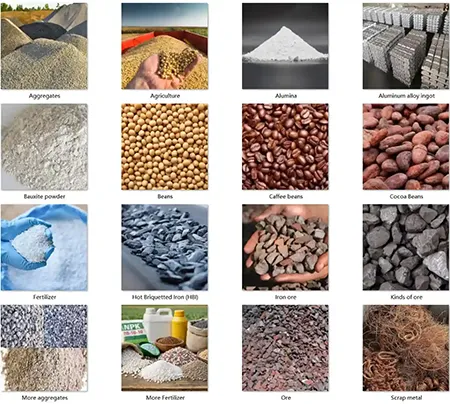
Container tilters are commonly used for a wide range of bulk materials.
Typical applications include:
Fertilizer and potash
Potash and other fertilizers can be transported in bulk inside shipping containers. Because some fertilizer products do not flow freely under gravity, a vibrating system can be added to the container tilter to improve material discharge.
Minerals and mineral powders
Materials such as bauxite powder and alumina can be unloaded by tilting the container toward a receiving hopper or conveyor.
Grain and agricultural products
Bulk grain can be discharged directly from a tilted container into downstream conveying or storage equipment.
Salt
Bulk salt can be unloaded using a container tilter and transferred to a hopper or conveyor for further processing.
Biomass and other bulk products
A suitable container tilting system can also be designed for biomass and other granular or powdered materials.
Scrap metal
For certain scrap metal applications, a heavy-duty container tilter can be used to rotate the container to a high unloading angle, allowing excavators or other equipment to load and unload irregular heavy materials.
The appropriate machine configuration depends on the material density, flowability, container size, payload, unloading angle and downstream handling system.
Container Tilter vs. Other Container Handling Equipment
Not every machine that moves a shipping container is designed to unload its contents.
A forklift, for example, can move certain containers or containerized loads, but it is not normally designed to safely tilt a fully loaded ISO container to a controlled unloading angle.
A reach stacker is designed primarily for lifting and transporting containers. It can position a container, but it does not replace a dedicated container tilting system when controlled bulk unloading is required.
A container lifter can lift a container vertically from a truck, which is useful where there is no crane or other container-handling equipment. However, lifting and tilting are different functions.
A container tilter, by contrast, is specifically engineered to support, secure and hydraulically tilt the container for unloading.
| Equipment | Main Function | Tilts Container for Unloading? |
|---|---|---|
| Forklift | Move loads and containers | Generally no |
| Reach stacker | Lift and move containers | Generally no |
| Container lifting system | Lift container on/off truck | Not primarily |
| Container tilter | Tilt container for bulk unloading | Yes |
| Container flipper | Rotate/tilt container for unloading and other applications | Yes, depending on design |
Therefore, if the specific requirement is “I have a shipping container filled with bulk material and I want to tilt it for unloading,” a dedicated container tilter is the type of machine to consider.
Hydraulic Container Tilter for Heavy-Duty Unloading
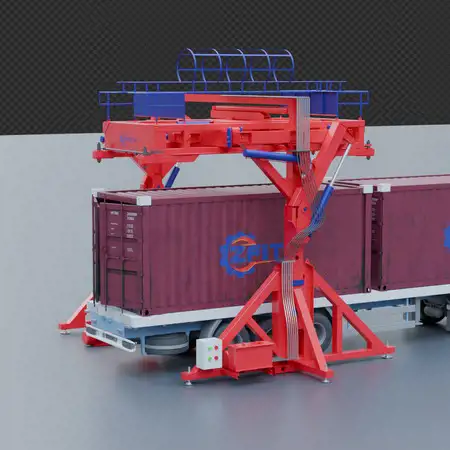
ZFITA Container Tilters are designed for heavy-duty container loading and unloading applications.
The equipment uses a hydraulic lifting system to raise and tilt standard 20 ft and 40 ft ISO containers. Depending on the application, the system can be configured for different container handling methods, unloading angles, capacities and control requirements.
The machine can be designed to work with:
- Truck-mounted container handling
- Reach stacker or forklift handling
- Receiving hoppers
- Belt conveyors
- Vibrating discharge systems
- Weighing systems
- Automated or semi-automated controls
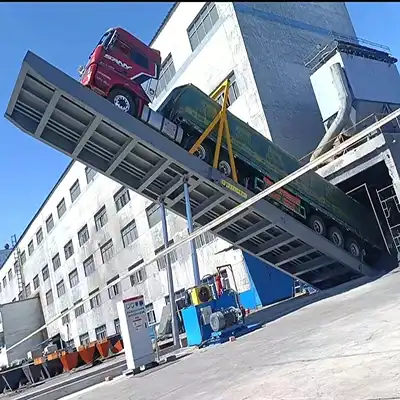
For applications where the container remains on the truck during the unloading process, a truck-compatible configuration can be used. Other configurations allow the container to be handled by a reach stacker, forklift or other container-handling equipment before and after the tilting operation.
What If the Material Does Not Flow Out Completely?
Gravity alone is not always enough.
Some bulk materials have relatively poor flowability, may bridge inside the container, or may stick to the container floor and walls. Fertilizer and potash, for example, can require additional assistance to achieve more complete discharge.
In these applications, a vibration system can be integrated with the container tilter.
The container is first tilted to create the main material flow. Controlled vibration then helps loosen remaining material and move it toward the container doors.
This combination can be useful when the goal is not simply to tilt the container, but to achieve a more complete unloading process.
How Do You Choose the Right Container Tilter?
The correct container tilter should be selected based on the complete unloading process rather than container dimensions alone.
Important factors include:
Container size
The machine should be suitable for the required 20 ft, 40 ft or other ISO container dimensions.
Payload
The equipment must be designed for the maximum combined working load of the container and material.
Material characteristics
Bulk density, particle size, moisture content, flowability and material behavior can significantly affect the unloading design.
Required tilting angle
Different materials and unloading systems may require different tilting angles.
Container handling method
Consider whether the container arrives on a truck, is handled by a reach stacker, or is positioned by a forklift or other equipment.
Downstream equipment
The tilter should be coordinated with the receiving hopper, conveyor, truck loading system, weighing system or other equipment used after unloading.
Automation requirements
Manual, semi-automatic and fully automatic operating configurations can be considered depending on the required production capacity and operating environment.
A Container Tilter Can Be Part of a Complete Unloading System
In many bulk material applications, the container tilter is only one part of the material-handling process.
For example:
Shipping container → Container Tilter → Receiving Hopper → Conveyor → Storage or Processing
For truck-based operations, the system can also be arranged around the truck unloading position.
This approach allows the container unloading process to be designed as a complete material-handling solution rather than treating the tilter as an independent machine.
ZFITA Container Tilter
ZFITA provides hydraulic container tilting equipment for bulk material handling applications involving standard shipping containers.
Our container tilters can be engineered according to the container size, payload, material characteristics, unloading method and downstream equipment.
Typical applications include fertilizer, potash, minerals, grain, salt, biomass and scrap materials.
For materials with poor flowability, vibration systems can also be incorporated to improve discharge performance.
If you are looking for a machine that can tilt a shipping container for unloading, the key question is not simply how to rotate the container, but how the container, material, truck, unloading equipment and downstream conveying system should work together.
ZFITA can help develop the container tilting and bulk unloading configuration around your specific application.
Need to unload bulk material from a 20 ft or 40 ft shipping container? Contact ZFITA to discuss your container size, material, payload and unloading requirements.