What Equipment Is Used to Unload Bulk Materials from Containers?
Unloading bulk materials from shipping containers can be challenging, especially when large quantities of material need to be removed efficiently with minimal manual labor.
Traditional unloading methods may require workers to enter the container and manually remove material, or use forklifts and other handling equipment. For larger-scale operations, dedicated container unloading equipment can provide a safer, faster, and more controlled approach.
The most suitable equipment depends on the material characteristics, container size, gross weight, unloading requirements, and whether the equipment is needed only for unloading or also for other container handling operations.
For bulk material applications, the main options include container tilters, container flippers, and manual or forklift-assisted unloading methods.
What Equipment Is Used to Unload Bulk Materials from Containers?
The most common approaches are:
- Container Tilter – raises and tilts the container to approximately 90° for controlled, gravity-assisted unloading.
- Container Flipper – rotates the container up to 90° to either side, providing greater flexibility for unloading and other container handling operations.
- Manual or Forklift-Assisted Unloading – uses workers or conventional handling equipment and is generally more suitable for smaller-scale operations.
For high-volume bulk material unloading where the material can flow under gravity, a hydraulic container tilter is often an efficient solution.
1. Container Tilter
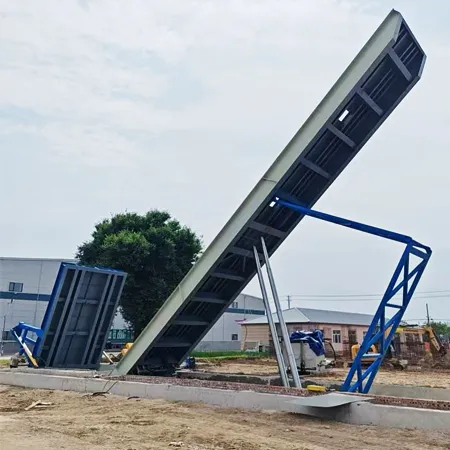
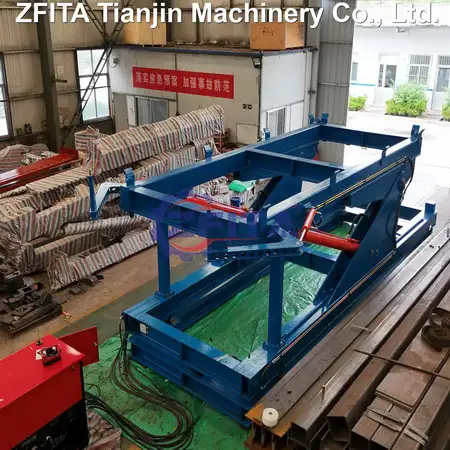
A container tilter is designed to raise and tilt a shipping container from its normal horizontal position to a near-vertical position, typically around 90 degrees.
The main purpose is to use the change in container angle to help bulk material discharge through the container opening under gravity.
Once the container reaches the required unloading position, materials such as grain, pellets, biomass, minerals, agricultural products, and other free-flowing bulk materials can move toward the opening without requiring workers to manually remove the entire load.
How Does a Container Tilter Work?
A typical hydraulic container tilter operates through a controlled lifting mechanism.
First, the container is positioned securely on the tilter and locked in place.
The hydraulic cylinders then raise one end of the equipment, gradually changing the container’s orientation.
As the container approaches the vertical unloading position, gravity causes the bulk material to move toward the container door.
After the unloading operation is completed, the hydraulic system lowers the container back to its horizontal position.
The actual lifting capacity and operating angle should be determined according to the container’s gross weight, material characteristics, and equipment design.
Why Use a Container Tilter?
A container tilter can provide several advantages:
- Reduced manual labor – gravity performs much of the unloading work.
- Faster unloading – large quantities of bulk material can be discharged in a controlled operation.
- Controlled movement – hydraulic systems allow the container to be raised and lowered gradually.
- Improved operator efficiency – workers do not need to manually remove large quantities of material from inside the container.
- Suitable for industrial applications – the system can be designed for high container weights and repeated operation.
For bulk materials that flow effectively under gravity, a container tilter can be a practical alternative to labor-intensive unloading methods.
2. Container Flipper
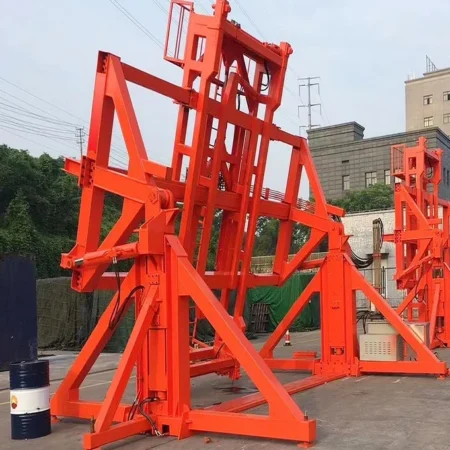
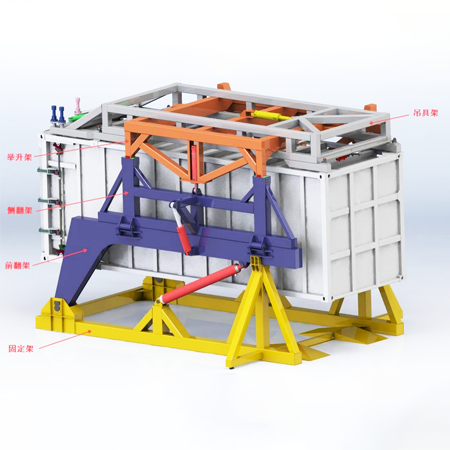
A container flipper is designed to rotate a shipping container to either side, typically up to 90 degrees in either direction.
This means the container can generally be rotated approximately +90° or -90°, depending on the equipment configuration.
Some manufacturers and users refer to this as a 180° container flipper. In this context, the 180° figure refers to the total available rotation range from one side to the other, rather than the container being physically turned upside down through a full 180-degree rotation.
The distinction is important when comparing container handling equipment.
What Is a Container Flipper Used For?
A container flipper has applications beyond bulk material unloading.
Depending on its configuration, it can be used for:
- Bulk material unloading
- Container positioning
- Container cleaning
- Container maintenance
- Container inspection
- Welding and repair work
- Container modification
- Accessing different sides or surfaces of a container
For maintenance and fabrication operations, the ability to rotate the container to a more convenient working position can provide significant practical benefits.
Instead of requiring workers to work around a horizontally positioned container, the flipper can reposition the container so that the required surface or area is easier to access.
Container Tilter vs. Container Flipper
Although both machines can rotate shipping containers, their typical applications are different.
A container tilter is primarily designed for bulk material loading or unloading, with the container typically raised to approximately 90° to facilitate gravity-assisted material discharge.
A container flipper, by contrast, provides bidirectional rotation and can be used not only for unloading but also for container maintenance, repair, welding, cleaning, inspection, and modification.
Therefore, a container flipper can be considered a more versatile container positioning system when the project involves both material handling and container service operations.
3. Manual or Forklift-Assisted Unloading
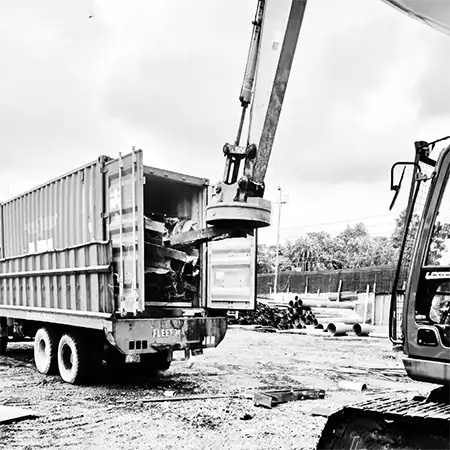
Manual unloading remains common in smaller operations or situations where dedicated container handling equipment is not economically justified.
Depending on the material and packaging, workers may manually remove material from the container, while forklifts or other equipment can be used to handle accessible loads.
However, these methods become less efficient when dealing with large quantities of loose bulk material.
Common limitations include:
- High labor requirements
- Longer unloading times
- Greater dependence on operators
- Difficult working conditions
- Limited unloading productivity
- Increased manual handling
Forklifts can be useful for packaged goods or materials that can be accessed and handled mechanically, but they are not always an efficient solution for loose bulk materials distributed throughout a shipping container.
For high-volume bulk material operations, dedicated container handling equipment can significantly reduce manual intervention.
Container Tilter vs. Container Flipper vs. Manual Unloading
The appropriate solution depends on the intended operation.
| Equipment | Typical Rotation | Primary Application | Labor Requirement | Key Advantage |
|---|---|---|---|---|
| Container Tilter | Approx. 90° | Bulk material loading and unloading | Low | Efficient gravity-assisted unloading |
| Container Flipper | Up to ±90° | Unloading, maintenance, repair, welding and positioning | Low | Bidirectional rotation and versatility |
| Manual Unloading | None | Small-scale or simple operations | High | Low equipment investment |
| Forklift-Assisted | None | Packaged or accessible materials | Medium–High | Flexible conventional handling |
There is no universal solution for every container unloading application.
A container tilter is generally more appropriate when the primary objective is bulk material unloading through controlled container tilting.
A container flipper is more suitable when the project requires bidirectional container rotation and additional functions such as maintenance, repair, welding, or cleaning.
Manual or forklift-assisted methods may remain appropriate for smaller-scale operations.
What Factors Determine the Right Container Unloading Equipment?
Before selecting container unloading equipment, several factors should be considered.
Material Characteristics
The physical characteristics of the material have a direct impact on unloading performance.
Free-flowing materials such as grain, pellets, and certain minerals can often discharge effectively when the container is inclined.
Materials with higher cohesion, moisture content, or a tendency to compact may require additional consideration during equipment selection.
Container Size and Gross Weight
The equipment must be designed for the actual container configuration and operating load.
Important parameters include:
- 20-foot or 40-foot container
- Container tare weight
- Maximum payload
- Maximum gross weight
- Container dimensions
- Door configuration
The supplier should clearly define the rated lifting capacity and the conditions under which that capacity applies.
Required Unloading Productivity
The required number of containers to be unloaded per day can influence the equipment configuration.
A small operation may be able to use manual methods, while a high-volume facility may benefit significantly from a dedicated hydraulic container handling system.
Available Space
The available installation area should also be considered.
The equipment needs sufficient space for container positioning, lifting, rotation, operator access, and material discharge.
For projects with limited space, the equipment dimensions and operating envelope should be reviewed during the design stage.
Future Applications
The intended use of the equipment should not be overlooked.
If the equipment will only be used for bulk material unloading, a container tilter may be sufficient.
If the customer also needs to inspect, repair, weld, clean, or modify containers, a container flipper may provide greater long-term versatility.
How Does a Hydraulic Container Tilter Unload Bulk Materials?
The operating principle of a hydraulic container tilter is relatively straightforward.
Step 1: Container positioning
The shipping container is placed securely onto the tilter.
Step 2: Container locking
The container is secured using the appropriate locking mechanism before lifting begins.
Step 3: Hydraulic lifting
Hydraulic cylinders raise the equipment and gradually change the container’s orientation.
Step 4: Gravity-assisted discharge
As the container approaches the unloading position, gravity causes the bulk material to move toward the open end.
Step 5: Material discharge
The bulk material exits the container into the designated receiving area, hopper, or downstream handling point.
Step 6: Return to horizontal position
After unloading, the hydraulic system lowers the container back to its original position.
The lifting speed, unloading angle, and operating sequence should be determined according to the specific equipment design and application requirements.
Why Is a Container Flipper Useful Beyond Unloading?
One of the major advantages of a container flipper is its ability to reposition the entire container for purposes other than material handling.
Container maintenance can be difficult when the container remains in its normal horizontal position.
A flipper can rotate the container toward the required side, making different surfaces and areas more accessible.
This can be useful for:
- Welding work
- Structural repairs
- Floor repairs
- Cleaning
- Inspection
- Painting
- Container modification
- General maintenance
This makes a container flipper particularly valuable for container repair facilities, maintenance yards, logistics companies, and operations that need to handle both containers and bulk materials.
Which Equipment Should You Choose?
The choice should be based on the main purpose of the equipment.
Choose a Container Tilter When:
- Bulk material unloading is the primary application.
- The material can flow under gravity.
- A controlled approximately 90° tilt is required.
- You want to reduce manual unloading.
- The equipment will operate repeatedly at an industrial facility.
Consider a Container Flipper When:
- The container needs to rotate to either side.
- The application requires up to ±90° rotation.
- Bulk material unloading is required.
- Container maintenance is also required.
- Welding, repair, cleaning, inspection, or modification work is part of the operation.
- A more versatile container positioning system is desired.
Consider Manual or Forklift-Assisted Unloading When:
- The operation is relatively small.
- Container volumes are limited.
- The material is packaged or easily accessible.
- Dedicated container handling equipment cannot be economically justified.
ZFITA Container Unloading and Handling Equipment
ZFITA is a China-based bulk material handling solutions provider specializing in container handling, truck handling, conveying, and weighing equipment.
Its container handling product range includes container tilters and container flippers, with equipment configurations designed for different container sizes, load capacities, operating requirements, and site conditions.
ZFITA container tilters are designed primarily for controlled container tilting and bulk material loading or unloading operations. The approximately 90-degree working position allows gravity to assist the discharge of bulk materials from the container.
For applications requiring bidirectional container rotation, ZFITA also provides container flipper solutions. These systems can rotate a container to either side and can be used for bulk material unloading as well as container maintenance applications such as repair, welding, cleaning, inspection, and modification.
This makes the equipment suitable for both material handling operations and specialized container service applications.
ZFITA’s broader product portfolio also includes container transfer systems, telescopic container loaders, container straddle carriers, mobile truck loading conveyors, truck dumpers, truck weighbridges, and bulk material handling equipment.
The equipment can be configured according to the customer’s container specifications, material characteristics, required capacity, site layout, and operating process.
Final Considerations
The right container unloading equipment depends on the material, container weight, operating requirements, and intended use of the equipment.
For bulk materials that can discharge effectively under gravity, a container tilter provides a straightforward and efficient approach by raising the container to approximately 90 degrees.
When the project requires the container to rotate to either side, a container flipper provides greater flexibility. With rotation of up to approximately ±90°, it can support not only unloading operations but also container maintenance, repair, welding, cleaning, inspection, and modification.
Manual and forklift-assisted unloading methods remain suitable for smaller or less demanding applications, but they generally require more labor and provide lower productivity for large quantities of loose bulk materials.
For industrial operations, the best solution is therefore determined not simply by the container type, but by the material characteristics, required capacity, unloading process, site conditions, and future applications of the equipment.
If you are planning a container unloading project, provide the container size, gross weight, material type, required unloading capacity, and site conditions to an equipment manufacturer. These details will help determine whether a container tilter, container flipper, or another container handling solution is the most suitable choice.