Vertical Container Loading Equipment for Bulk Materials
Load grain, fertilizers, minerals and other suitable dry bulk materials into 20ft and 40ft shipping containers with hydraulic container tilters, controlled feeding equipment and project-specific loading configurations.
What Problems Does Inclined Container Loading Solve?
Choosing the right container loading equipment begins with your material, the way you receive empty containers and the required loading rate—not with a single tilting angle.
Material Distribution
Gravity can help suitable free-flowing materials move toward the lower end of an inclined container during filling.
Container Positioning
Coordinate the loading station with trucks, forklifts, reach stackers or a compatible crane, depending on the model.
Site Constraints
Plan safe clearances for the container, feeder, tilting frame and vehicle circulation before selecting equipment.
Weight & Flow Control
Match feeding rate and bulk density to container payload limits, with weighing where the project requires it.
How Does Vertical Container Loading Work?
“Vertical” here includes inclined loading. The container does not have to reach 90°. The required angle depends on cargo behavior, feeding equipment and the selected hydraulic tilter.
Position
Deliver the empty container by truck or external lifting equipment.
Lock
Secure the container and verify the model's operating interlocks.
Tilt
Raise to a safe loading angle within the equipment's rated range.
Feed
Introduce bulk material through the designated opening with a suitable feeder.
Release
Stop feed, return to horizontal, secure the container and verify weight.
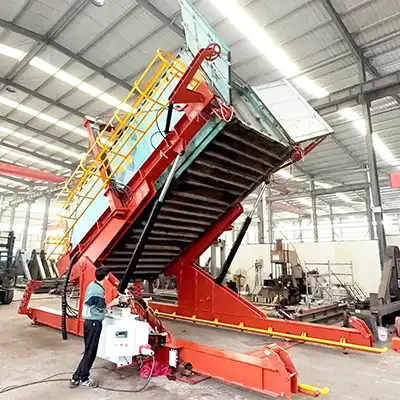
Equipment Angle ≠ Loading Method
A 20ft tilter may offer a 0–90° range while a 40ft configuration may operate within 0–45°. Both can be used in inclined container loading if the material and feeder arrangement are compatible.
What Equipment Makes Up a Container Loading System?
A hydraulic container tilter is the primary handling machine. A workable loading station also needs a suitable material feed path, correct container positioning and the relevant safety and weight controls.
Hydraulic Container Tilter
Supports, locks and raises the container. Model selection depends on container size, operating weight and loading angle.
Feeding Conveyor & Hopper
Belt conveyors, screw conveyors, feed hoppers or chutes can be selected based on material properties and required throughput.
Positioning & Locking
Truck-coordinated or external lifting arrangements with model-appropriate securing and verification procedures.
Optional Weighing
Specified when in-process weight monitoring is required. Not assumed to be standard on all models.
Controls & Safety
Local or remote operation, emergency stops, guarding and interlocks according to the selected model.
Dust & Site Integration
Material-specific dust containment and connections to existing silos, conveyors or upstream feed points.
20ft vs. 40ft Container Loading Equipment
Use the model's actual tilting range—not a universal 90° claim—to judge suitability for your material and loading method.
| Model | ISO Container | Rated Load | Tilting Range | Recommended Selection |
|---|---|---|---|---|
| ZCT-ATT20 | 20ft | 40,000 kg | 0–90° | Dedicated 20ft loading requiring a broad angle range |
| ZCT-ATT40 | 40ft | 40,000 kg | 0–45° | 40ft inclined loading where material flow suits the available angle |
| ZCT-ATT20/40 | 20ft and 40ft | 40,000 kg | 0–45° | Mixed container sizes using a convertible support arrangement |
Published configurations only. Equipment rated load is not the allowed payload of an ISO container; container and transportation limits still apply.
Which Container Loading Equipment Fits Your Site?
All four ZFITA container tilter series can have loading applications, but they solve different positioning and site-layout problems.
Standard Hydraulic Container Tilter
20ft, 40ft and convertible configurations for truck-coordinated, dedicated loading stations. Select according to container length, capacity and required tilt.
ATT20ATT40ATT20/40Single & Dual Side Container Tilter
20ft ZCF35-SS and ZCF35-DD configurations for single-lane/single-side or dual-lane/dual-side operation. Select by truck approach and discharge or filling direction.
ZCF35-SSZCF35-DDSS: 0–90°; DD: ±90°. Confirm the final layout, capacity and operating sequence.
Self-Propelled Mobile Container Tilter
For yards where equipment needs to move between designated loading points. 20ft reference model, with 40ft and convertible custom configurations available.
Mobile 20ftMobile 40ftForklift & Reach Stacker Container Tilter
For sites already using suitable external lifting equipment. Includes loading-focused ZCT-ZM20 / ZCT-ZM/CC20 and the combined loading/unloading ZCT-AZM/CC20.
Reach StackerForkliftWhich Bulk Materials Can Be Loaded?
The right solution depends on material bulk density, moisture, flowability, particle size and any special handling hazards. The examples below are potential applications, not guarantees for every cargo.
Grain & Agriculture
Evaluate flowability, dust, moisture and any food-grade liner or contamination controls.
Fertilizers
Check granular flow, corrosion or moisture sensitivity and appropriate contact materials.
Minerals
Account for bulk density, abrasive particles and container permitted weight.
Plastic Pellets
Specify controlled feeding, prevention of contamination and suitable liners if required.
Dry Chemicals
Confirm chemical compatibility, dust hazards and site-specific safety requirements.
Selected Recyclables
Assess irregular shape, impacts, particle size and protection for the container interior.
Vertical / Inclined vs. Horizontal Container Loading
Choose based on actual handling sequence—not a claim that one method is universally faster or more efficient.
Vertical / Inclined Loading
Core equipment: Hydraulic container tilter + feeder.
Container position: Tilted at a chosen angle.
Selection focus: Flowability, allowable angle, container locking, feed connection and rated capacity.
Horizontal Loading
Core equipment: Horizontal loading feeder.
Container position: Remains level after external lifting and positioning.
Selection focus: Feeder compatibility, container placement method, loading path and site logistics.
What Should You Confirm Before Buying Container Loading Equipment?
These inputs allow ZFITA to propose a working loading station—not just a container tilter with a generic specification sheet.
Loading Process
- Material name, bulk density and flowability
- Particle size, moisture and dust requirements
- 20ft, 40ft or mixed container sizes
- Target tonnes per hour and containers per shift
- Container liners and door arrangements
Equipment & Site
- Gross container weight and permitted payload
- Truck, forklift, reach stacker or crane positioning
- Available floor area, clearances and ground conditions
- Power supply and upstream feed location
- Optional weighing, control and safety requirements
Container Loading Equipment Manufacturer in China
ZFITA supplies hydraulic container-handling machines and project-specific loading equipment configurations. Our manufacturing and integration scope covers structural steel fabrication, hydraulic assembly, mechanical integration, electrical controls and equipment testing.
We can review tilter selection, feeding equipment interfaces, container positioning, control options and installation planning to suit the proposed loading operation.
CONTACT US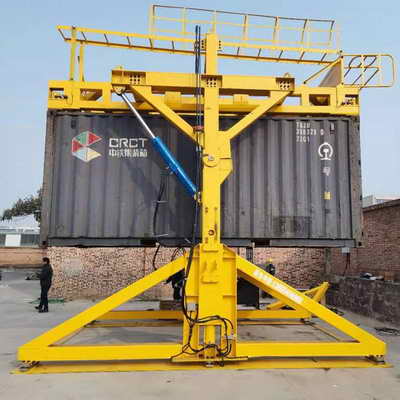 .
Vertical Container Loading FAQ
Does vertical container loading always require 90° tilting?
No. It also includes inclined loading. The required angle is determined by the model, cargo characteristics and feeding arrangement; ZCT-ATT20 is 0–90°, while listed ATT40 and ATT20/40 models are 0–45°.
What equipment is required for a complete container loading station?
A suitable container tilter, container positioning and securing equipment, and a matched material feeder. Weighing, dust control and other auxiliary equipment depend on the project.
Can one tilter load both 20ft and 40ft containers?
Yes, where a convertible design is selected. The listed ZCT-ATT20/40 supports both lengths with a specified tilting range of 0–45°.
Can a 40ft container be loaded at 90°?
Not with the listed ZCT-ATT40 configuration, which is rated for 0–45°. Any different 40ft angle requirement needs separate engineering confirmation.
Is vertical container loading suitable for every bulk material?
No. Wet, cohesive, fragile, abrasive or hazardous materials may need a different feeding method, a different tilt angle or additional controls.
Is a weighing system included?
Weighing is optional on applicable configurations. The weighing scope, accuracy and calibration requirements should be confirmed in the equipment proposal.
Can mobile tilters be used for loading?
Yes, if the mobile model and its feed connection, ground conditions and operating arrangement are suitable for the project.
Can ZFITA provide an integrated loading solution?
ZFITA can review container tilters together with feeders, positioning, optional weighing and equipment interfaces. Final supply scope is agreed for the project.
Request a Container Loading Equipment Quotation
Tell us your material, container size, loading rate, gross weight and site conditions. We will review the appropriate tilter, feeding configuration and optional systems for your operation.
- Material and bulk density
- Container: 20ft / 40ft / both
- Tonnes per hour / containers per shift
- Maximum container gross weight
- Truck or external lifting positioning
- Floor plan and available utilities
- Feeder, weighing and dust-control needs
- Target loading angle if specified