Unloading fertilizer and potash from shipping containers can be more difficult than handling ordinary free-flowing bulk materials.
During transportation, fertilizer granules may absorb moisture, become compacted, or form lumps. Potash and certain compound fertilizers can also stick to container surfaces or retain material after the main discharge is completed.
For fertilizer importers, port terminals, storage facilities, and blending plants, these problems may increase unloading time and leave residual cargo inside the container.
A hydraulic container tilter provides a gravity-assisted method for unloading compatible dry fertilizers. For materials that do not discharge freely, the equipment may be combined with a properly engineered vibration system, receiving hopper, and downstream conveyor.
This guide explains how fertilizer container unloading works, when vibration assistance may be useful, which equipment is required, and how to select a suitable unloading configuration.
1. Why Is Fertilizer Difficult to Unload from Shipping Containers?
Fertilizers are transported in different physical forms, including granules, prills, powder, and compacted bulk material.
Their unloading behavior varies according to chemical composition, particle size, moisture content, storage conditions, and transportation history.
Moisture Absorption
Some fertilizer products are hygroscopic, meaning they can absorb moisture from the surrounding environment.
Moisture absorption may cause particles to stick together and reduce their ability to flow through the container discharge opening.
Caking and Compaction
During long-distance transportation, fertilizers may experience pressure from the cargo above, temperature changes, and repeated vibration.
These conditions can contribute to caking, where individual particles form larger agglomerates.
The result may be slower unloading or material remaining inside the container.
Material Bridging
When bulk material forms a stable arch or obstruction near a discharge opening, the flow can slow or stop.
Increasing the container tilt angle may not always resolve the problem.
Residual Material
Even after most of the cargo has discharged, some fertilizer may remain on the container floor, walls, or around the discharge interface.
Residual material can increase cleaning requirements and extend the unloading cycle.
For these reasons, a fertilizer unloading system should be selected according to the actual behavior of the cargo rather than the container size alone.
2. How Does a Hydraulic Container Tilter Unload Fertilizer?
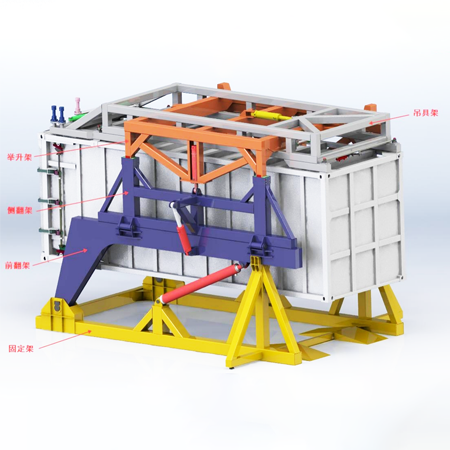
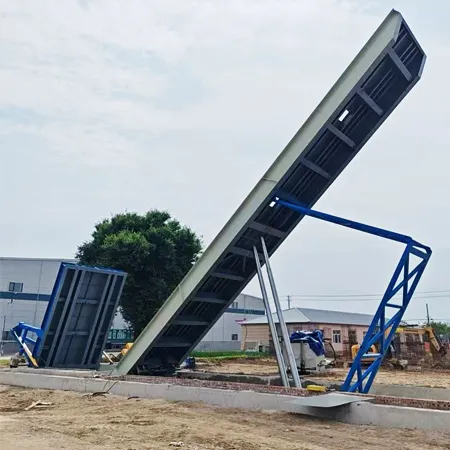
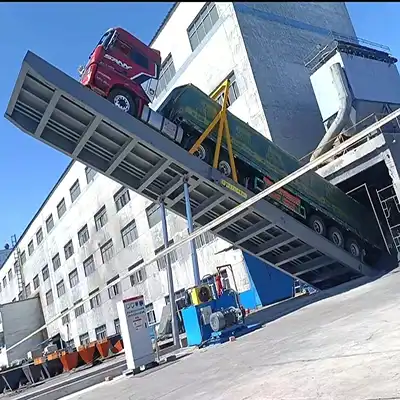
A container tilter secures a shipping container to a supporting structure and uses hydraulic cylinders to move it to a controlled unloading angle.
The container’s inclination allows suitable bulk materials to travel toward the designated outlet under gravity.
A typical unloading process includes the following stages.
Step 1: Position the Container
The loaded shipping container is brought to the unloading station using a compatible truck or container-handling arrangement.
The operating procedure depends on the selected container tilter.
Step 2: Secure the Container
The equipment’s container locking mechanisms are engaged.
Operators verify the container condition, cargo information, locking status, and discharge arrangement before beginning the movement.
Step 3: Prepare the Unloading Outlet
The container door, liner, bulkhead, and receiving hopper arrangements must be prepared according to an approved unloading procedure.
Uncontrolled opening of doors against a bulk load must be avoided.
Step 4: Tilt the Container
The hydraulic system gradually raises the container to the appropriate operating angle.
Fertilizer begins moving toward the outlet when the material and discharge geometry allow gravity flow.
Step 5: Assist Material Discharge if Required
For certain materials with reduced flowability, engineered vibration assistance may help loosen residual material.
Vibration settings must be selected for the specific cargo, container, and equipment structure.
Step 6: Complete Unloading
The material is collected by the receiving hopper and transferred to the next process.
After discharge is complete, the container is returned to its initial position and released according to the operating procedure.
3. When Does Fertilizer Unloading Require Vibration Assistance?
Gravity-assisted unloading works best when the material moves freely at the selected container angle.
However, some fertilizers may become partially compacted during storage or transportation.
In these situations, vibration assistance may be considered.
How Does Vibration Assistance Work?
A vibration system applies controlled mechanical excitation to an engineered part of the unloading arrangement.
The objective is to help mobilize material that remains after the primary gravity discharge.
Depending on the design, it may assist with reducing residual material buildup or encouraging movement toward the outlet.
ZFITA describes vibration assistance as an available configuration for selected fertilizer and potash unloading applications.
Is Vibration Necessary for Every Fertilizer?
No.
Free-flowing fertilizer granules may unload adequately without vibration.
Moreover, excessive or unsuitable vibration can create other problems, including particle degradation, segregation, increased structural loading, or equipment wear.
If material has hardened into large cohesive masses, vibration alone may not resolve the problem safely.
The supplier should assess material samples, flow characteristics, structural limits, and the proposed unloading procedure before recommending vibration assistance.
What Should Buyers Confirm?
Before requesting a vibration-assisted container tilter, buyers should provide:
- Fertilizer type and chemical composition.
- Particle size and bulk density.
- Moisture content and storage conditions.
- History of caking or residual material.
- Container loading and discharge arrangements.
- Target unloading rate.
- Available receiving equipment.
A properly selected system should address the actual cause of poor discharge rather than simply increasing vibration intensity.
4. What Fertilizers Can Be Handled with a Container Tilter?
Different fertilizer products require different handling considerations.
| Fertilizer Material | Potential Handling Issue | Equipment Consideration |
|---|---|---|
| Potash / MOP | Moisture absorption, caking, residual material | Flow testing, controlled discharge, corrosion protection |
| NPK Granular Fertilizer | Variable granule size, moisture sensitivity | Hopper geometry, gentle transfer, dust management |
| Urea | Moisture sensitivity and possible caking | Dry handling, suitable material-contact surfaces |
| Phosphate Fertilizer | Dust, abrasion, variable flowability | Wear protection and receiving-system compatibility |
| Other Dry Fertilizers | Product-specific behavior | Check SDS, material characteristics and equipment compatibility |
These are general material-handling considerations, not guarantees that any particular container tilter can safely unload every product listed.
Certain fertilizers, especially ammonium-nitrate-based products, can have additional regulatory and safety requirements. Their compatibility must be established through the specific product’s safety documentation and an appropriate engineering review.
For a broader overview, read What Bulk Materials Can a Container Tilter Unload?.
5. What Equipment Is Needed for a Complete Fertilizer Container Unloading System?
A complete unloading station may require more than the hydraulic container tilter.
The equipment must safely receive the fertilizer and transfer it to storage, blending, packaging, or processing operations.
| Equipment | Function | Buyer Consideration |
|---|---|---|
| Hydraulic Container Tilter | Secures and tilts the loaded container | Container size, gross load and angle |
| Optional Vibration System | Assists selected difficult-flowing materials | Material response and structural compatibility |
| Receiving Hopper | Collects discharged fertilizer | Capacity, geometry and flow behavior |
| Feeder | Regulates material entering the conveyor | Controlled feed rate and blockage prevention |
| Conveyor | Transfers material downstream | Capacity, material compatibility and distance |
| Dust Collection | Helps manage dust emissions | Product hazards and site requirements |
| Control System | Coordinates equipment operation | Interlocks, operating sequence and emergency functions |
A typical material flow is:
Shipping Container → Hydraulic Container Tilter → Receiving Hopper → Feeder → Conveyor → Fertilizer Storage or Processing
If the facility already has suitable receiving and conveying equipment, the project may only require a container tilter and appropriate connection arrangements.
For a new facility, the unloading system should be planned as an integrated process.
Learn more about Bulk Container Unloading Equipment & Systems.
6. How to Select a Container Tilter for Potash and Fertilizer
The correct equipment depends on the cargo, container, site arrangement, and required unloading performance.
Container Size and Gross Weight
Confirm whether the facility receives 20ft, 40ft, or both container sizes.
The equipment must accommodate the container’s actual gross weight and specified locking points.
Material Flow Characteristics
Provide representative material information, including bulk density, moisture content, particle size, and known caking behavior.
For challenging products, material-flow testing may be useful before finalizing the system design.
Required Tilting Angle
Some equipment configurations support high container tilting angles, but the maximum available angle is model-dependent.
The correct angle should be determined by cargo behavior and the discharge arrangement.
Vibration Requirements
Determine whether the material normally flows by gravity or requires additional assistance.
Where vibration is proposed, confirm that the container, supporting frame, vibration system, and locking arrangement are designed for the additional dynamic loads.
Corrosion and Material Compatibility
Certain fertilizers can contribute to corrosion, particularly when moisture is present.
Check the proposed steel protection system, coatings, seals, cleaning arrangements, and material-contact components.
Receiving and Conveying Capacity
The receiving equipment should accommodate the expected discharge characteristics without creating material backup.
Conveyor capacity must also match the facility’s required unloading throughput.
Site and Operating Conditions
Consider truck access, available space, foundation conditions, power supply, weather exposure, and operational safety.
Container-handling arrangements may differ between truck-based and forklift or reach-stacker-supported operations.
7. Which ZFITA Container Tilter Configuration Is Suitable?
ZFITA offers several hydraulic container tilter configurations that may be considered for compatible fertilizer unloading projects.
For example, the 20ft Hydraulic Container Tilter is designed for standard 20ft containers and has published specifications including a 40-tonne rated lifting capacity and a 0–90° tilting range.
ZFITA also offers a Container Tilter for Forklift and Reach-Stacker Operations for sites that use separate container-handling equipment.
These machines differ in container positioning and operating arrangements.
The selected model should be evaluated against the fertilizer type, actual payload, desired unloading method, and available infrastructure.
Vibration assistance and other optional functions should be confirmed in the technical proposal rather than assumed to be included in every model.
8. What Information Should Buyers Send to a Fertilizer Container Tilter Supplier?
Preparing the right project information helps suppliers propose suitable equipment and clarify the total scope of supply.
| Requirement | Information to Provide |
|---|---|
| Fertilizer | Potash, NPK, urea, phosphate or other specific product |
| Cargo Properties | Bulk density, particle size, moisture and flowability |
| Container Type | 20ft, 40ft or other specified configuration |
| Maximum Weight | Loaded container gross weight |
| Discharge Challenges | Caking, bridging or residual material |
| Unloading Capacity | Containers per shift or required tonnes per hour |
| Site Layout | Truck access, available space and unloading location |
| Existing Equipment | Hopper, feeder, conveyor or storage connections |
| Optional Requirements | Vibration, weighing, dust collection or special coatings |
| Delivery Scope | Standalone equipment or integrated unloading system |
Buyers should request model-specific technical drawings, component specifications, operating requirements, and a clear description of included and excluded equipment.
9. Frequently Asked Questions
Can a container tilter unload potash fertilizer?
Yes, a suitable hydraulic container tilter can be configured for potash unloading. Actual equipment selection depends on container size, loaded weight, flowability and unloading conditions.
Why does potash sometimes become difficult to unload?
Potash can absorb moisture and cake during transportation or storage. This may reduce its ability to flow freely and leave material inside the container.
Does every fertilizer container tilter need a vibration system?
No. Vibration is a possible option for certain materials with poor discharge characteristics, not a universal requirement.
Can vibration remove completely hardened fertilizer?
Not necessarily. Severely caked material may require a different handling procedure. Material condition and safety must be evaluated before attempting discharge.
Can the same equipment unload NPK, urea and potash?
A suitable configuration may handle multiple compatible materials, but product-specific safety, corrosion, cleaning and flow characteristics must be checked.
Is a container tilter different from a fertilizer unloading conveyor?
Yes. The container tilter tilts the shipping container. The conveyor transfers the discharged fertilizer toward storage or processing. They can work together in one unloading system.
Can ZFITA supply the complete unloading arrangement?
ZFITA provides hydraulic container tilting equipment and can review integration with receiving hoppers, feeders and conveying equipment. The final equipment scope should be established through the technical proposal.
Conclusion
Unloading fertilizer and potash from shipping containers requires an understanding of both the hydraulic equipment and the material being handled.
Moisture, caking, compaction and residual material can affect unloading performance. For suitable products, a hydraulic container tilter provides gravity-assisted discharge, while a properly engineered vibration system may help address certain difficult-flowing conditions.
However, successful equipment selection depends on container weight, material characteristics, hydraulic configuration, receiving capacity and the overall operating process.
For available equipment configurations, explore the ZFITA Container Tilter Product Range.
If you are planning a potash or fertilizer container unloading station, provide your cargo information, container specifications, required throughput and site layout for a project-specific equipment evaluation.