Efficient Vertical Loading for Bulk Materials
When bulk materials need to be loaded into a shipping container efficiently, the loading method can have a major impact on operating efficiency, equipment requirements, and overall handling costs. For applications where the container can be positioned vertically, shipping container vertical loading equipment provides a practical solution for loading dry bulk materials while reducing the need for complex handling operations.
ZFITA designs and supplies hydraulic equipment for vertical container loading, including heavy-duty container tilters and integrated bulk material handling systems. These systems are designed for applications involving fertilizer, grain, salt, coal, minerals, biomass, plastic resin and other dry bulk materials.
What Is Shipping Container Vertical Loading Equipment?
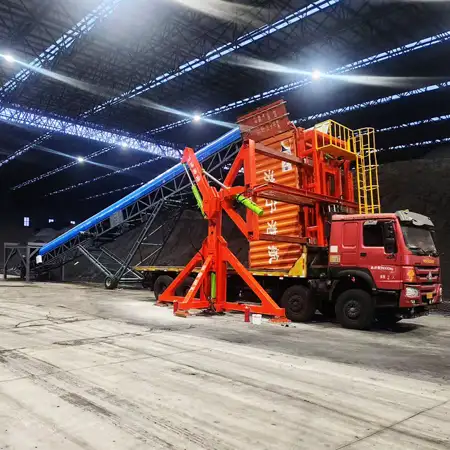
Shipping container vertical loading equipment is machinery used to raise or tilt a shipping container into a vertical or near-vertical position for bulk material loading.
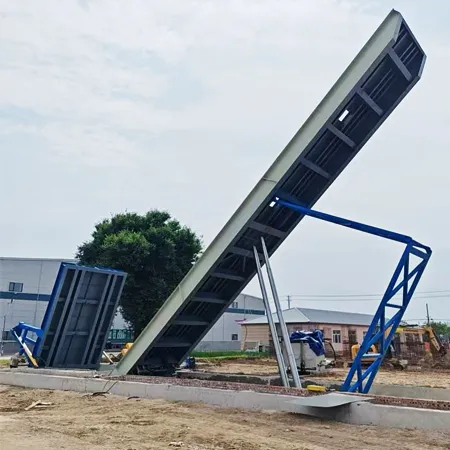
Instead of keeping the container horizontal and extending a conveyor or loading spout into the container, a hydraulic container tilter changes the position of the container itself. Once the container reaches the required angle, bulk material can be loaded from the top using a conveyor, hopper, chute, or other feeding equipment.
This loading method is particularly useful when the material handling system is designed around gravity-assisted filling.
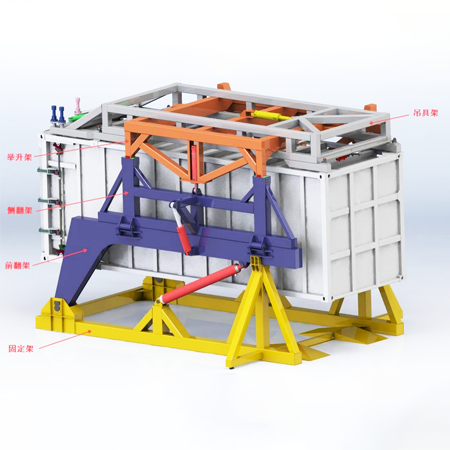
A typical vertical container loading system can include:
- Hydraulic container tilter
- Hydraulic power unit
- Container locking and securing system
- Belt conveyor or feeding conveyor
- Loading hopper or chute
- Control system
- Safety interlocks
- Remote control system
- Optional weighing system
The exact configuration depends on the material, container size, required capacity, site layout, and loading process.
How Does Vertical Container Loading Work?
The basic principle is straightforward.
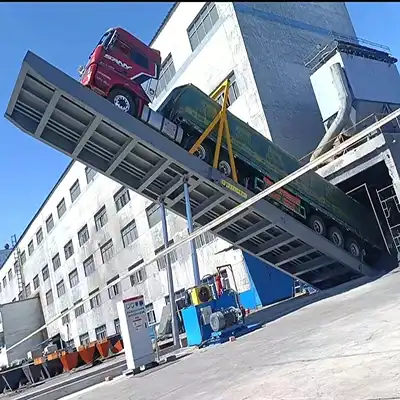
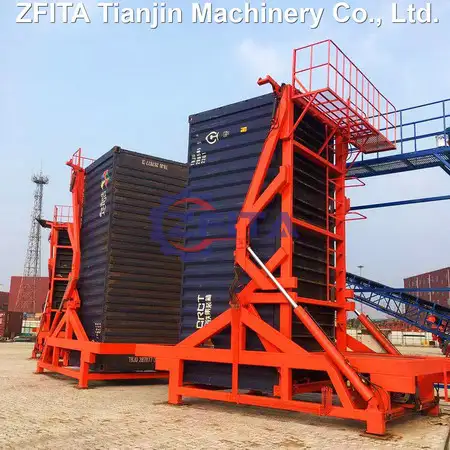
First, an empty 20 ft or 40 ft shipping container is positioned on the container tilter. Depending on the equipment configuration, the container may be loaded onto the tilter by a truck, reach stacker, forklift, crane, or other container-handling equipment.
After the container is properly positioned and locked, the hydraulic system raises one end of the container. The container can then be placed at a suitable angle for loading.
Bulk material is supplied through a conveyor, hopper, chute, or other feeding system. Because the container is tilted, the material can flow toward the lower end of the container and distribute along its internal space.
After loading is completed, the hydraulic system returns the container to the horizontal transport position.
This process allows the shipping container vertical loading equipment to become part of a complete bulk material loading system rather than operating as an isolated machine.
Why Use Vertical Loading for Shipping Containers?
Different loading applications require different equipment. Horizontal loading is often suitable when the container and truck need to remain in their original positions. However, vertical loading can offer specific advantages when the site and material handling process are better suited to gravity-assisted filling.
Better Access to the Container
Tilting the container provides a large opening at the upper end, allowing bulk material to enter more directly.
This can simplify the connection between the feeding conveyor and the container and can reduce the need for long telescopic loading equipment in some applications.
Suitable for Bulk Materials
Vertical container loading is particularly suitable for dry bulk products that can flow through a conveyor, hopper, or chute.
Typical materials include:
- Fertilizer
- Potash
- Salt
- Grain
- Corn
- Wheat
- Coal
- Minerals
- Bauxite powder
- Cement
- Plastic resin
- Biomass
- Other dry bulk materials
Material characteristics should always be considered when selecting the loading system. Particle size, moisture content, flowability, bulk density, and dust generation can affect the conveyor and feeding equipment required.
Integration With Conveying Systems
One of the main advantages of a vertical loading system is that the container tilter and conveyor system can be engineered together.
ZFITA can design belt conveyors according to the required capacity and material characteristics. Conveyor widths can range from approximately 650 mm to 1600 mm, depending on the application.
For materials that tend to roll back on an inclined belt, a chevron belt can be used. For applications requiring very steep conveying angles, high-sidewall corrugated belt conveyors can also be considered.
This makes it possible to develop a complete system from material feeding to container loading.
Hydraulic Container Tilter for Vertical Loading
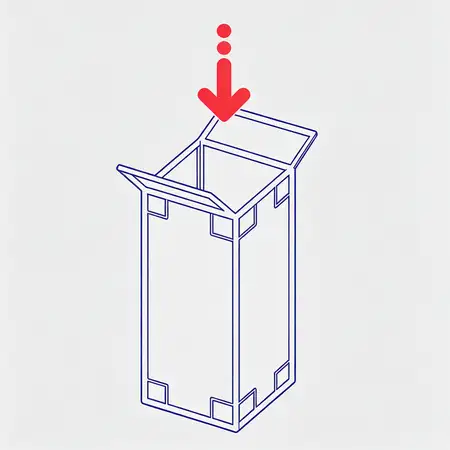
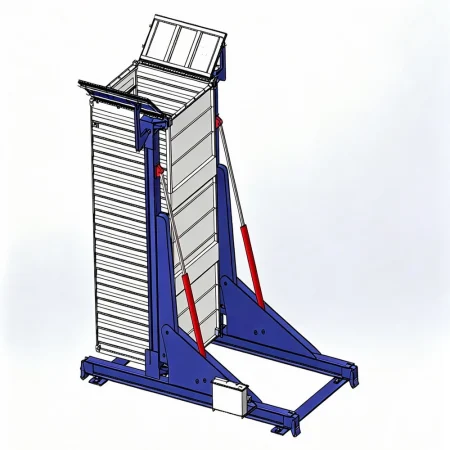
The hydraulic container tilter is the core component of many vertical container loading systems.
Unlike a conventional conveyor that moves material toward a stationary container, the container tilter changes the position of the container itself.
ZFITA container tilters can be designed for 20 ft and 40 ft ISO containers and can be configured for different loading environments.
Depending on the project, available options can include:
- Manual, semi-automatic, or automatic operation
- Hydraulic container locking
- Remote control
- Weighing sensors
- Central lubrication
- Safety interlocks
- Customized loading angles
- Integrated conveyor systems
- Customized hydraulic and electrical controls
The equipment can also be engineered for demanding industrial environments where durability and long-term reliability are more important than appearance.
Vertical Loading vs. Horizontal Container Loading
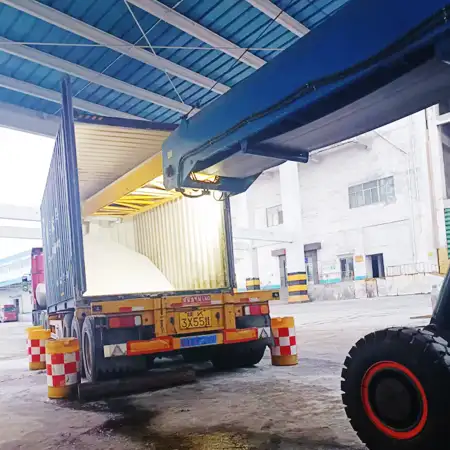
The choice between vertical and horizontal container loading depends primarily on the application.
In a horizontal loading system, the container normally remains on the truck or another supporting platform while a conveyor, telescopic loader, or loading spout extends into the container.
In a vertical loading system, the container is tilted by hydraulic equipment before or during the loading process.
Neither method is universally suitable for every application.
Horizontal loading can be useful when the container needs to remain connected to the truck or when site height restrictions make vertical positioning impractical.
Vertical loading can be useful when the project benefits from a large top opening, gravity-assisted material distribution, or integration with an existing conveyor and hopper system.
The material properties, available space, required loading capacity, container handling method, and truck/container configuration should therefore be considered together.
Shipping Container Vertical Loading Equipment With Conveyor Systems
For many bulk material projects, the container tilter is only one part of the complete loading solution.
A typical ZFITA system may integrate:
Bulk material → hopper → belt conveyor → container tilter → shipping container
The conveyor transports material from the storage, processing, or feeding point to the container. The container tilter positions the container at the required angle, while the feeding system delivers the material into the container.
This integrated approach can be particularly useful for projects where the customer needs a complete loading system rather than a standalone machine.
ZFITA can engineer the equipment according to the customer’s site conditions, material characteristics, loading capacity, container dimensions, and operating requirements.
What Should You Consider When Selecting Vertical Container Loading Equipment?
Several technical factors should be evaluated before selecting shipping container vertical loading equipment.
Container Size
The system should be designed according to the container types being handled, such as 20 ft and 40 ft ISO containers. High-cube containers may also require specific consideration.
Material Characteristics
The material’s flowability, moisture, density, particle size, and abrasiveness influence the selection of conveyors and feeding equipment.
For materials with poor flowability, additional measures may be required to achieve stable and complete loading.
Required Capacity
The required loading rate should be determined before selecting the conveyor and feeding system. The equipment can then be matched to the target throughput and operating cycle.
Site Conditions
Available space, foundation conditions, loading height, truck access, container handling equipment, and electrical requirements all influence the system design.
Safety
A hydraulic container tilter handles a heavy container and therefore requires appropriate mechanical locking, hydraulic protection, electrical interlocks, and operator controls.
The complete system should be engineered according to the applicable safety requirements and operating environment.
ZFITA Shipping Container Vertical Loading Solutions
ZFITA provides shipping container vertical loading equipment for bulk material handling applications worldwide.
Our approach is not limited to supplying a single machine. We can engineer the container tilter together with conveyors, hoppers, feeding systems, weighing equipment, and electrical controls to create a complete container loading solution.
Our hydraulic container tilters are designed for heavy-duty industrial applications and can be customized according to container size, material characteristics, loading capacity, site conditions, and operating requirements.
For projects where a shipping container needs to be loaded vertically with bulk material, a hydraulic container tilter combined with a properly designed conveying system can provide an efficient and flexible solution.
Contact ZFITA to discuss your container size, material, required capacity, and site conditions, and we can recommend a suitable vertical container loading system.