Unloading mineral powder from shipping containers presents different challenges from handling grain, fertilizer, or other free-flowing bulk materials.
Mineral powders may have high bulk density, fine particle sizes, abrasive characteristics, or poor flowability. During transportation, some materials can become compacted or adhere to the container liner, making complete discharge more difficult.
For mining companies, mineral processors, import terminals, and industrial raw material distributors, selecting suitable mineral powder container unloading equipment requires more than checking the rated capacity of a machine.
A hydraulic container tilter can provide gravity-assisted unloading for compatible mineral materials. Depending on the cargo, the unloading arrangement may also require a controlled discharge interface, receiving hopper, dust collection, suitable feeder, and downstream conveyor.
This guide explains how mineral powder container unloading works, which technical challenges should be considered, and how to select equipment for an industrial receiving operation.
1. Why Is Mineral Powder Difficult to Unload?
Mineral powders vary significantly in their physical characteristics.
Some granular minerals discharge relatively easily under gravity, while fine or cohesive powders may flow slowly, form obstructions, or remain inside the container after the main discharge.
High Bulk Density
Mineral powders may be substantially denser than agricultural products.
A container carrying a dense mineral can reach its allowable payload before the container is completely filled.
Equipment selection must therefore consider the actual loaded container weight, container structural limits, and the rated capacity of the tilter.
Dust Generation
Fine mineral particles may become airborne during discharge and transfer.
Uncontrolled dust can create housekeeping problems, material loss, equipment contamination, and occupational exposure concerns.
The specific hazards depend on the mineral composition and particle characteristics.
Abrasion and Wear
Certain mineral products contain hard, abrasive particles.
These materials can accelerate wear on receiving hoppers, transfer chutes, feeders, conveyor components, and other material-contact surfaces.
Poor Flowability
Fine powders may develop cohesive behavior, especially when moisture, particle shape, compaction, or electrostatic effects influence the material.
Some powders can form stable accumulations or discharge intermittently rather than flowing continuously.
For this reason, the unloading system should be selected according to material testing and operating conditions—not simply the container size.
2. How Does a Hydraulic Container Tilter Unload Mineral Powder?
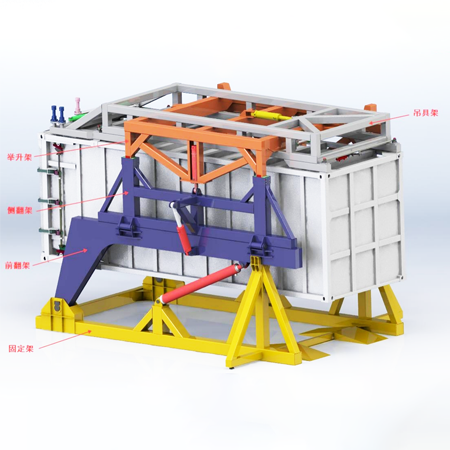
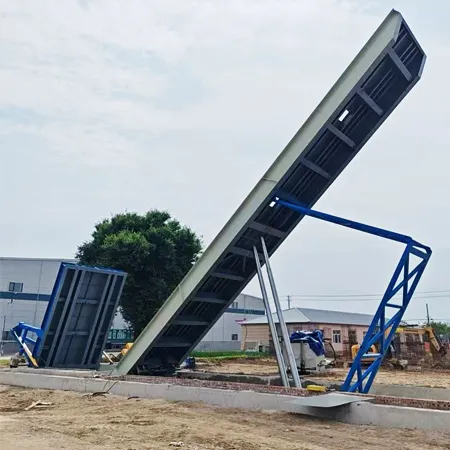
A hydraulic container tilter secures a shipping container and moves it to a controlled unloading angle.
The purpose is to direct suitable bulk material toward a designated discharge opening using gravity.
The machine’s actual operating procedure depends on its configuration and the container’s loading arrangement.
Step 1: Position the Loaded Container
The container is delivered to the unloading station and positioned according to the equipment’s handling requirements.
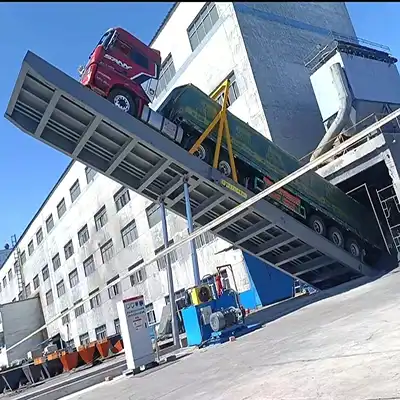
Some systems are coordinated with delivery trucks, while others use forklifts, reach stackers, or other container-handling equipment.
Step 2: Secure the Container
The container is secured to the tilting frame using the specified locking mechanisms.
The operator verifies the loaded weight, container condition, securing status, and operating area before movement.
Step 3: Prepare the Discharge Interface
A suitable container liner, bulkhead, outlet, and receiving connection must be prepared according to the approved procedure.
The system must prevent uncontrolled release of powder when the container doors or discharge interface are accessed.
Step 4: Begin Controlled Tilting
The hydraulic system gradually tilts the container to a suitable angle.
Compatible material begins moving toward the outlet.
The appropriate operating angle depends on material flowability, discharge geometry, and the machine’s specified limits.
Step 5: Transfer Mineral Powder
The discharged material enters the receiving hopper or another designed collection interface.
A feeder regulates transfer into the downstream conveyor or processing system.
Step 6: Complete Unloading
After discharge is complete, the system is checked for residual material and returned to its normal position in accordance with the equipment operating procedure.
3. What Equipment Is Required for Mineral Powder Container Unloading?
A complete unloading arrangement may include several connected machines.
| Equipment | Main Function | Important Selection Factors |
|---|---|---|
| Hydraulic Container Tilter | Tilts and supports the loaded container | Gross weight, container size, operating angle |
| Discharge Connection | Controls material leaving the container | Outlet geometry, liner, sealing |
| Receiving Hopper | Collects discharged mineral material | Capacity, flowability, abrasion |
| Feeder | Controls material flow to downstream equipment | Required throughput and material behavior |
| Conveyor | Transfers minerals to storage or processing | Distance, capacity, sealing, wear |
| Dust Collection | Helps capture airborne particles | Dust characteristics and exposure controls |
| Monitoring and Controls | Coordinates equipment operations | Interlocks, discharge control, material level |
A typical arrangement follows this sequence:
Loaded Container → Hydraulic Container Tilter → Controlled Discharge → Receiving Hopper → Feeder → Conveyor → Storage or Processing
The configuration depends on the mineral and the receiving facility.
For a wider explanation of integrated equipment, see Bulk Container Unloading Equipment & Systems.
4. How Should Different Mineral Powders Be Handled?
Not all mineral powders behave the same way.
The following examples illustrate common selection considerations.
| Material | Potential Handling Challenge | Engineering Consideration |
|---|---|---|
| Bauxite Powder | Density, moisture and particle variability | Rated load, flowability and hopper design |
| Alumina | Fine particles and dust generation | Enclosed transfer and suitable dust control |
| Limestone Powder | Fine-powder flow restrictions | Discharge outlet and feeder selection |
| Mineral Concentrates | Density, abrasion and variable moisture | Structural load, wear protection and controlled discharge |
| Silica-Containing Materials | Potential respirable dust exposure | Appropriate exposure assessment and dust containment |
| Other Industrial Minerals | Material-specific behavior | Test the actual product before equipment selection |
This table provides general handling considerations. It does not establish automatic compatibility between any listed material and a particular machine.
For example, a dry granular bauxite product may discharge differently from a very fine bauxite powder with higher moisture content.
Similarly, not all mineral concentrates are suitable for gravity-only unloading.
For a broader material overview, read What Bulk Materials Can a Container Tilter Unload?.
5. How Can Dust Be Controlled During Mineral Powder Unloading?
Dust control is particularly important when unloading fine mineral materials.
The required measures depend on particle size, composition, discharge rate, and site conditions.
Controlled Discharge Connection
An engineered discharge connection can help prevent material from escaping through uncontrolled openings.
For suitable bulk liner systems, a sealed outlet or enclosed connection may be considered.
Enclosed Receiving Hopper
The receiving hopper can be designed with covers or other containment features to reduce the escape of airborne material.
Dust Extraction
Where required, local extraction and appropriate filtration can capture dust generated at discharge and transfer points.
The system should be designed for the actual material and applicable safety requirements.
Enclosed Conveying
Covered belt conveyors, screw conveyors, or suitable enclosed transfer equipment may be used depending on material properties and process requirements.
Dust control is not only an environmental consideration. It can also influence equipment maintenance, product recovery, operator exposure, and facility cleanliness.
For related engineering considerations, see Container Tilter Dust Control During Bulk Unloading.
[IMAGE 3 — Mineral Powder Hopper and Dust Collection]
Suggested image: A receiving hopper connected to an enclosed conveying or dust extraction system.
6. How Do High Density and Abrasion Affect Equipment Selection?
Mineral handling equipment should be evaluated using the actual material weight and mechanical operating conditions.
Rated Container Weight
The rated capacity of the hydraulic container tilter must be compatible with the maximum loaded container weight.
The supplier should verify the machine’s permitted loading configuration and container securing arrangement.
Hopper and Chute Wear
Abrasive minerals can cause wear at impact and transfer points.
Depending on the material and operating duty, suitable liners, replaceable wear surfaces, and appropriate chute geometry may be needed.
Conveyor Selection
Different conveying methods may be suitable for different mineral materials.
The choice depends on the required capacity, particle characteristics, transfer distance, dust containment, and abrasion.
Residual Material
Highly cohesive powders may remain inside the container even when it is tilted.
Increasing the tilt angle does not always solve the problem and should never exceed the equipment’s specified operating range.
In some applications, engineered discharge-assistance systems may be needed.
7. Which Container Tilter Configuration Is Suitable for Minerals?
ZFITA offers several hydraulic container tilter configurations that can be evaluated for mineral handling projects.
Standard 20ft Hydraulic Container Tilter
The ZFITA 20ft Container Tilter is intended for standard ISO 20ft containers.
The published ZCT-ATT20 configuration includes a rated lifting capacity of 40,000 kg and a 0–90° tilting range.
These values apply to the specified model and must not be treated as universal ratings for other configurations.
Self-Propelled Mobile Container Tilter
The ZFITA Self-Propelled Mobile Container Tilter combines container tilting with mobility for suitable industrial yard operations.
This configuration may be evaluated where container handling and unloading locations need greater flexibility.
Container Tilter for Forklift and Reach-Stacker Operations
The ZFITA Hydraulic Container Tilter for Forklift and Reach Stacker is designed for facilities using separate container-handling equipment.
It may be relevant where containers are transferred independently of the delivery truck.
The most suitable configuration depends on the material, container size, site layout, and existing machinery—not simply the model name.
8. How to Choose a Mineral Powder Container Unloading System
Before purchasing equipment, buyers should confirm the following technical requirements.
Material Characteristics
Provide the exact mineral type, bulk density, particle size distribution, moisture range, and relevant safety documentation.
For difficult-flowing powders, the supplier may require material-flow testing.
Container Size and Weight
Confirm 20ft or 40ft compatibility and provide the maximum loaded container weight.
Container selection must also account for cargo weight limits and the required container handling arrangement.
Required Throughput
Specify the expected containers per shift and the required downstream material transfer rate.
Both the container handling cycle and the material discharge process affect total unloading performance.
Site Layout
Provide the unloading station dimensions, truck access, foundation information, discharge height, and existing equipment arrangement.
Dust and Wear Requirements
Identify dust exposure requirements, abrasive characteristics, and any special environmental or process constraints.
Scope of Supply
Clarify whether the project requires only the hydraulic tilter or also a receiving hopper, feeder, conveyor, dust collection, and integrated controls.
9. What Should Buyers Send to a Container Tilter Supplier?
A useful technical inquiry should include the following information.
| Requirement | Information to Provide |
|---|---|
| Material | Exact mineral name and grade |
| Material Properties | Bulk density, particle size, moisture, flowability |
| Container | 20ft / 40ft and loading arrangement |
| Maximum Load | Gross container weight |
| Capacity | Containers per hour or shift; required tonnes per hour |
| Site Layout | Dimensions, truck access, foundation and clearances |
| Container Handling | Truck, forklift, reach stacker or other equipment |
| Receiving System | Hopper, feeder, conveyor and storage connections |
| Environmental Requirements | Dust management, exposure control and wear protection |
| Supply Scope | Standalone machine or integrated system |
Buyers should also request equipment drawings, applicable technical specifications, installation requirements, and a clear description of included accessories.
For equipment options, visit the ZFITA Container Tilter Product Range.
10. Frequently Asked Questions
Can a container tilter unload bauxite powder?
A suitably configured hydraulic container tilter may be used for compatible bauxite powder. The final solution must be checked against material density, moisture, flowability, container weight, and discharge requirements.
Can a container tilter handle alumina?
Certain configurations can be considered for alumina handling. Fine-powder flow behavior, dust containment, and appropriate downstream equipment require particular attention.
Does mineral powder unloading require dust collection?
Not every material requires an identical system, but fine dusty materials often need appropriate containment and extraction measures. The actual requirements depend on the material and site conditions.
Does a higher tilt angle guarantee complete unloading?
No. Cohesive powders may remain inside the container even at a steep angle. Equipment operation must remain within the manufacturer’s specified limits.
What is the difference between a container tilter and a mineral conveyor?
A container tilter changes the position of the secured container to assist discharge. A conveyor transfers the released material to the next stage of the process.
Can one unloading system handle different minerals?
Possibly, but compatibility must be evaluated for each mineral. Changes in density, particle size, abrasion, moisture, and dust hazards can require different equipment settings or components.
Conclusion
Mineral powder container unloading requires a coordinated approach to material flow, equipment loading, dust control, abrasion, and downstream transfer.
A hydraulic container tilter can provide gravity-assisted discharge for suitable mineral materials, but the best operating arrangement depends on the properties of the actual cargo.
For mining companies, mineral processors, and industrial import terminals, the purchasing decision should begin with the material, container, required throughput, and site layout.
ZFITA provides hydraulic container tilters and related bulk material handling equipment for project-specific evaluation.
Explore the ZFITA Container Tilter Product Range or review Bulk Container Unloading Equipment & Systems to identify a suitable equipment configuration.